A hybrid car can display a battery charge level that appears sufficient for electric driving, yet begin reducing power shortly after its gasoline tank becomes empty. To a driver, this can seem contradictory. If the electric motor is capable of moving the vehicle, and the battery still contains stored energy, why should the car stop operating simply because it has no gasoline?
The answer lies in the difference between having electrical energy available and having a powertrain designed to operate independently of its combustion engine.
A hybrid vehicle coordinates gasoline, electrical energy, battery management, and engine operation as parts of one system. Some models can continue moving electrically for a limited distance after fuel depletion. Others may restrict propulsion, refuse to maintain normal operation, or shut down when the engine can no longer perform a required function.
Understanding what happens when a hybrid car runs out of gas requires examining the vehicle’s architecture, battery reserve strategy, engine dependency, and protective control logic. It also requires distinguishing conventional hybrids from plug-in hybrids, because their electric-driving capabilities are fundamentally different.
The Battery Still Has Energy, but Is It Available for Propulsion?
Consider a hybrid vehicle whose fuel gauge reaches empty while the battery display still shows several bars. The driver may reasonably assume that the remaining battery charge can keep the vehicle moving.
That assumption overlooks an important feature of hybrid battery management: the displayed charge level does not necessarily represent energy that the manufacturer permits the driver to use independently of the gasoline engine.
Why hybrid batteries operate within a controlled reserve
Most conventional hybrids do not use their high-voltage batteries across the entire physical charging range available to the cells.
Instead, the battery management system maintains an operating window. It prevents excessive charging and discharging while preserving enough capacity for acceleration assistance, regenerative braking, and other powertrain requirements.
This operating strategy has several purposes:
- It protects cells from excessive voltage and current.
- It preserves room for energy recovered during deceleration.
- It maintains electrical power for acceleration assistance.
- It supports the engine’s start-stop strategy.
- It helps manage battery temperature and long-term durability.
The driver sees an estimated state of charge (SOC), but that value is not a promise that all the displayed energy can be used for continuous electric propulsion.
A conventional hybrid may deliberately retain a reserve because its battery is intended to work alongside the gasoline engine, not replace it indefinitely.
The difference between stored energy and usable power
Battery energy and battery power are related but different.
Energy determines how much electrical work can be delivered over time. Power describes how quickly that energy can be delivered.
A battery might contain enough energy to operate an electric motor at modest demand but still be unable to supply the power required for acceleration, climbing, or maintaining speed under difficult conditions.
The battery management system evaluates cell voltage, temperature, current, and other parameters to determine permitted charging and discharging power.
For example, cold cells can experience increased internal resistance and reduced power capability. High temperatures can also trigger power restrictions to limit further heating. A low state of charge may reduce the available discharge margin.
These limitations become particularly important when gasoline is unavailable. The engine can no longer provide its normal share of propulsion or help restore the battery’s operating reserve.
The vehicle may therefore have some electrical energy remaining without having enough available electrical power to continue normal driving.
What Changes Inside a Conventional Hybrid When the Fuel Supply Disappears?
A conventional hybrid electric vehicle (HEV) is designed around cooperation between its combustion engine and electric motor.
The engine supplies mechanical power, while the electric motor assists acceleration, recovers energy during braking, and may propel the vehicle independently under suitable conditions.
The control system continuously decides how to distribute these sources of power.
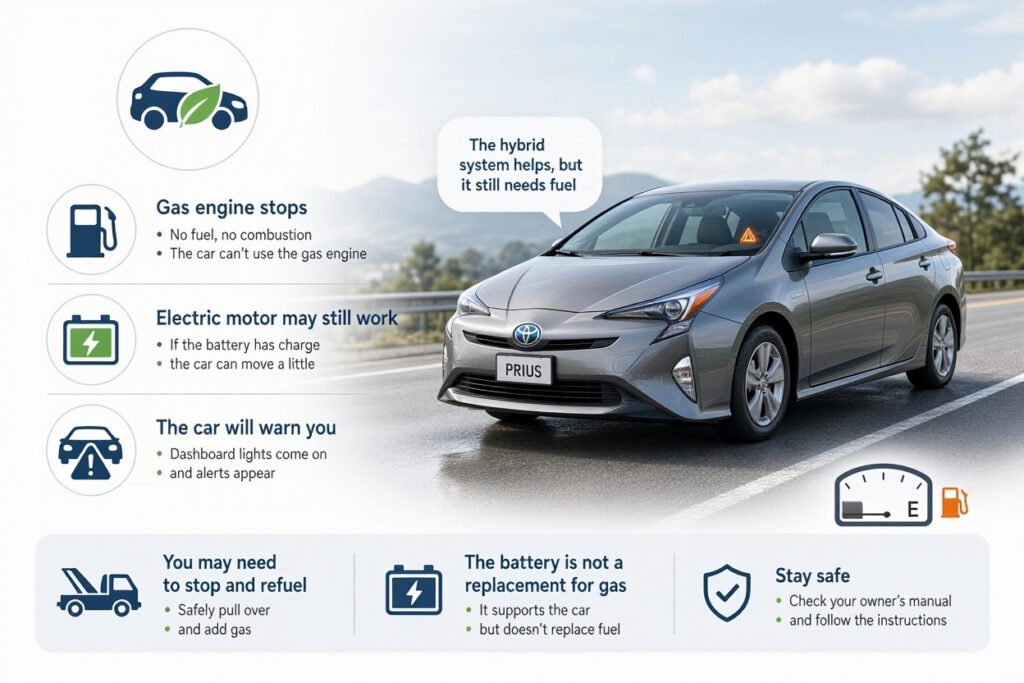
When gasoline runs out, that coordination becomes impossible in its normal form.
The engine can no longer provide mechanical power
A gasoline engine requires an adequate supply of fuel, air, and ignition energy to sustain combustion. Once the fuel supply is exhausted, the engine cannot continue producing useful combustion power.
Some engines may rotate briefly or attempt to restart, but without sufficient fuel delivery they cannot sustain normal operation.
The hybrid control system must then operate without one of its primary power sources.
In a parallel hybrid, the electric motor may be mechanically connected to the drivetrain and capable of moving the vehicle independently under certain conditions. However, its available power depends on the battery, motor, inverter, transmission arrangement, and control strategy.
In a power-split hybrid, the relationship between the engine, motor-generators, and planetary gearset is more integrated. The system may be capable of electric propulsion, but engine operation can still be important for maintaining the intended powertrain operating state.
A series hybrid has a different arrangement: the engine primarily drives a generator, while electric motors propel the vehicle. If the engine cannot supply fuel, the generator can no longer produce its normal electrical contribution.
These architectural differences help explain why two hybrid vehicles can respond differently to the same empty-fuel condition.
Why the electric motor may continue operating temporarily
A full hybrid generally has an electric motor capable of moving the vehicle under appropriate conditions.
If the battery contains sufficient usable energy and the control system permits electric propulsion, the vehicle may continue moving after the engine stops.
However, this does not establish a reliable electric-only range.
The remaining distance depends on several variables:
- Battery SOC at the moment fuel depletion occurs.
- Battery temperature and available discharge power.
- Vehicle speed and acceleration demand.
- Road gradient and vehicle load.
- Heating, air conditioning, and other electrical loads.
- Motor and inverter temperature.
- The manufacturer’s fuel-depletion control strategy.
A vehicle traveling slowly on level ground may require less propulsion power than one climbing a steep road with passengers and cargo.
Even when the battery initially has sufficient energy, sustained electrical demand can quickly reduce its reserve.
The vehicle may therefore continue briefly in one situation but lose propulsion capability much sooner under another.
Why a Conventional Hybrid Cannot Be Assumed to Work Like an Electric Car
The ability to move using an electric motor does not make every hybrid a battery-electric vehicle.
A conventional HEV normally has a comparatively small traction battery designed for repeated charging and discharging during ordinary driving.
Its energy-management strategy assumes that gasoline will remain available when the engine is needed.
This assumption influences battery sizing, cooling requirements, powertrain calibration, and the control system’s operating decisions.
Engine operation may be needed to restore battery charge
When battery SOC falls below its preferred operating range, many full hybrids use the gasoline engine to provide mechanical power and, through a motor-generator, electrical energy.
This allows the system to restore some of the battery’s operating reserve.
Without gasoline, that particular energy source is unavailable.
Regenerative braking may still recover part of the vehicle’s kinetic energy during deceleration, but it cannot create energy from nothing. It can recover only a portion of energy that would otherwise be lost through braking and other processes.
The recovered energy is also limited by battery charge acceptance, motor-generator capacity, inverter limits, vehicle speed, and the amount of available deceleration.
If the battery is already low, repeated acceleration can consume energy faster than braking events restore it.
Why regeneration cannot replace an engine indefinitely
Suppose a vehicle moves forward, accelerates, and then slows down. Regenerative braking can convert some of its kinetic energy into electricity.
However, the energy recovered during braking is less than the energy originally required to accelerate the vehicle because conversion losses occur throughout the process.
There are losses in the electric motor, inverter, battery, tires, drivetrain, and surrounding environment.
The vehicle also consumes energy through aerodynamic drag, rolling resistance, and electrical accessories.
Consequently, a hybrid cannot sustain ordinary driving indefinitely by repeatedly accelerating and regenerating.
Regeneration can extend the use of remaining battery energy under favorable conditions, but it cannot compensate for the permanent loss of the gasoline energy supply.
Plug-In Hybrids: A Different Relationship Between Gasoline and Electricity
Plug-in hybrid electric vehicles (PHEVs) are designed with a larger rechargeable battery than conventional hybrids. They can travel a substantial distance using electricity from an external charging source, depending on their design and operating conditions.
This creates a different situation when the gasoline tank becomes empty.
A PHEV may have enough battery energy to continue driving electrically because its battery was designed to support extended electric propulsion.
However, the ability to continue depends on whether the vehicle’s control system permits electric-only operation under the current conditions.
When a PHEV can continue without gasoline
A plug-in hybrid may continue operating in electric mode if:
- The battery has sufficient usable charge.
- The electric motor can provide the required propulsion power.
- Battery and motor temperatures remain within permitted limits.
- The vehicle is operating within its electric-mode restrictions.
- No engine-dependent system requires combustion-engine operation.
Under these conditions, an empty gasoline tank does not automatically mean that the vehicle must stop.
The vehicle may continue operating much like an electric car until its usable battery reserve becomes insufficient or its control system requests engine operation.
This is an important distinction from many conventional hybrids, whose smaller battery and energy-management strategy are not designed to provide extended independent electric driving.
Why even a PHEV may need its gasoline engine
A plug-in hybrid does not necessarily remain electric under every driving condition.
The engine may be required for power demand, temperature management, system protection, or a manufacturer-defined operating strategy.
For example, a vehicle may request engine operation when the driver demands more power than the electric system can provide under the current conditions.
Some PHEVs also use the engine for heating or other thermal-management functions, depending on their equipment and control strategy.
If gasoline is unavailable when the engine is requested, the vehicle may limit performance or display a warning.
The precise response varies by manufacturer and model. Some vehicles may continue in a restricted electric mode, while others may limit operation more severely.
The fact that a PHEV has a large battery therefore does not guarantee that it can satisfy every powertrain requirement without fuel.
The Hidden Role of Battery Temperature, Voltage, and State of Charge
Fuel depletion places additional importance on the battery because the electrical system may be asked to provide propulsion without the normal contribution from the engine.
This does not mean the battery suddenly becomes defective. It means the vehicle is operating under conditions that may be outside the assumptions of its normal energy-management strategy.
Low SOC and cell-voltage protection
As a battery discharges, its cell voltages generally decline, although the exact relationship depends on chemistry, temperature, current, and cell condition.
The battery management system monitors individual cells or groups of cells and prevents operation beyond permitted voltage boundaries.
A pack may have an acceptable overall voltage while one weaker cell approaches its lower operating limit.
Because cells connected in series carry the same current, the weakest cell can determine how much further the entire battery pack can safely discharge.
When the system approaches a protective boundary, it may reduce the permitted discharge current or power.
This can result in weaker acceleration, restricted propulsion, or a warning message.
If the system can no longer supply the electrical power required for safe vehicle operation, it may prevent continued propulsion.
Cold and hot battery conditions
Temperature also affects the amount of power available from a hybrid battery.
At low temperatures, electrochemical reactions become less responsive, and internal resistance may increase. The battery can deliver less power than it would under favorable thermal conditions.
At high temperatures, the battery management system may reduce power to control heat generation and protect cell life.
A vehicle with an already reduced battery reserve may therefore experience more severe limitations in cold or hot conditions.
This is one reason that the same hybrid may continue briefly after fuel depletion in moderate weather but behave differently when its battery is unusually cold or hot.
Why a displayed charge level can be misleading
The dashboard’s battery display is an estimate, not a direct measurement of the energy that can be used for propulsion without restrictions.
It also does not reveal the full condition of every battery cell.
A relatively high displayed SOC does not guarantee that the battery can supply continuous power indefinitely. Likewise, a low displayed SOC does not necessarily mean that the vehicle has reached the battery’s physical discharge limit.
The management system maintains safety margins that may not be visible to the driver.
When gasoline is unavailable, those margins become particularly important because the engine cannot provide its usual contribution to propulsion or battery-energy management.
What Protective Shutdown Actually Means
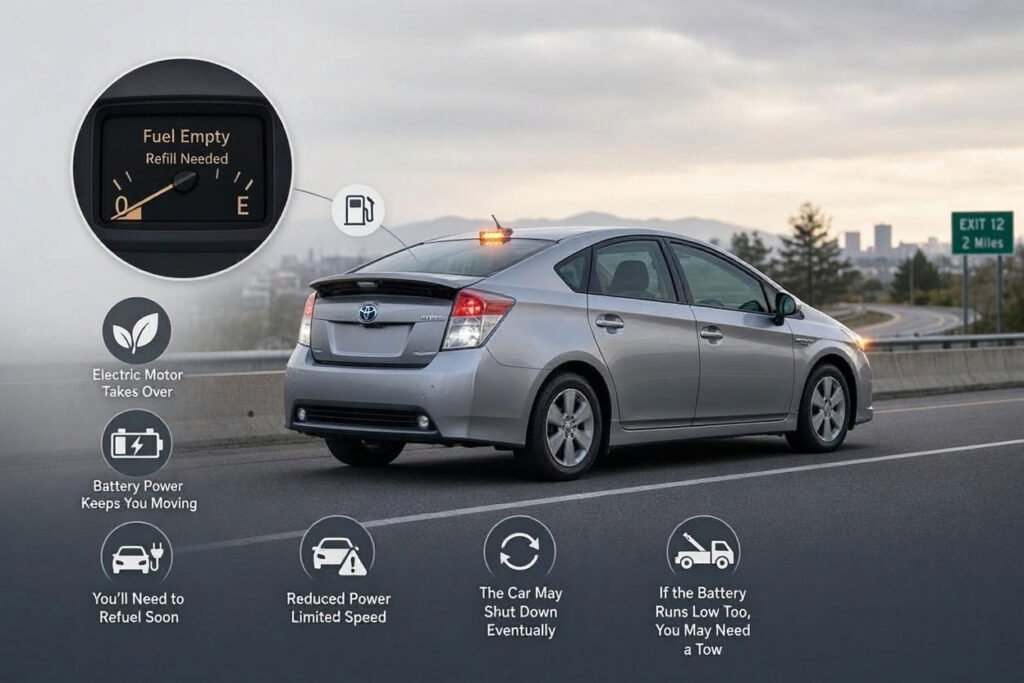
A hybrid does not necessarily shut down the instant its fuel gauge reaches empty.
The control system responds to the vehicle’s actual operating conditions, not merely the driver’s interpretation of the fuel display.
A fuel-level sensor may report an empty tank, but the engine may continue operating briefly if a small amount of usable fuel remains in the delivery system. Alternatively, fuel pressure may fall below the level required for reliable combustion, causing the engine to stop.
Once the engine can no longer run, the hybrid control system evaluates whether the remaining electrical system can support continued operation.
Reduced propulsion may come before complete shutdown
Depending on the model, the vehicle may respond to fuel depletion with:
- A low-fuel or fuel-system warning.
- A hybrid-system warning.
- Reduced acceleration.
- Restricted engine operation.
- Limited electric propulsion.
- A warning that the vehicle must be stopped safely.
These responses are not universal. Some models may display specific warnings, while others may behave differently depending on the fault conditions and remaining battery reserve.
The important point is that protective power limitation can occur before the vehicle becomes completely immobile.
Why the vehicle may eventually refuse to move
If the battery reaches a condition where it cannot safely provide the required propulsion power, the control system may disable driving capability.
This protects the battery from excessive discharge and prevents operation outside permitted electrical limits.
The vehicle may still have electrical power for displays, lighting, communication, and other low-voltage functions, but that does not mean the traction system remains available.
This distinction is similar to the difference between an illuminated dashboard and a vehicle that has successfully entered READY mode. Electrical activity alone does not establish that propulsion is available.
Why Running Out of Gas Can Create Additional Mechanical Problems
Fuel depletion is not only an energy-management issue. It can also create problems for the combustion-engine fuel system.
Fuel-pump operation and fuel delivery
Many gasoline vehicles use an electric fuel pump to deliver fuel from the tank to the engine.
When the tank is empty, the pump may no longer receive the fuel required for normal delivery. Depending on the system design and operating conditions, running the pump without adequate fuel can increase the risk of overheating or damage.
Repeated attempts to restart an engine without a usable fuel supply can also create unnecessary strain on the starting and fuel-delivery systems.
Hybrid vehicles may use different fuel-system arrangements, so the exact consequences are model-specific.
Fuel pickup and inaccurate fuel-level assumptions
The fuel gauge does not directly measure the precise amount of gasoline that can be delivered to the engine under every vehicle attitude and driving condition.
Fuel movement inside the tank, sensor calibration, tank shape, and vehicle inclination can affect the relationship between the displayed level and the fuel available at the pickup point.
A vehicle climbing a steep grade or cornering with a very low fuel level may experience fuel-delivery interruption before the driver expects it.
This is one reason that intentionally operating a hybrid until it stops is not a sensible way to test its electric range.
Restarting may not be immediate after refueling
After gasoline is added, some vehicles may require a short period for the fuel system to restore normal pressure or for the control system to recognize the restored fuel level.
A vehicle that does not restart immediately after refueling may therefore need diagnosis rather than repeated start attempts.
If the vehicle has entered a protective state or stored a fault, adding fuel alone may not restore normal operation.
The manufacturer’s refueling and restart instructions should take priority.
Series, Parallel, and Power-Split Hybrids: Why Architecture Changes the Outcome
The way a hybrid responds to fuel depletion is strongly influenced by how its engine and electric machines are connected.
Parallel hybrids can use an electric motor to provide propulsion through the mechanical drivetrain. Depending on motor capability and battery reserve, they may continue moving without the engine for a limited period. However, electric power availability and control restrictions determine whether that operation can be sustained.
Series hybrids use the engine primarily to drive a generator, while electric motors drive the wheels. If gasoline is unavailable, the generator loses its normal energy source. The vehicle must then rely on stored battery energy, subject to its electrical limits.
Power-split hybrids use a combination of mechanical and electrical power paths, often coordinated through a planetary gearset and motor-generators. Their ability to operate electrically depends on battery power, motor capability, and the manufacturer’s control strategy.
Mild hybrids are different again. They generally use a smaller electrical system to assist the combustion engine rather than provide sustained independent electric propulsion. If gasoline becomes unavailable, their ability to continue driving is usually much more limited than that of a full hybrid.
These categories explain the broad engineering differences, but they cannot predict the exact response of every vehicle. Individual models may have unique control strategies, operating restrictions, and emergency procedures.
A Practical Distinction: Temporary Electric Movement Is Not a Reliable Fuel Reserve
It is tempting to think of a hybrid battery as an emergency gasoline substitute. That is a misunderstanding of the system’s intended purpose.
The electric motor can provide propulsion, but the battery is sized and controlled according to the vehicle’s design. A conventional hybrid’s battery is normally managed around the assumption that the gasoline engine remains available.
A PHEV has greater electric-driving capability, but it still has engine-dependent operating conditions in many models.
Even when a vehicle continues moving after fuel depletion, its remaining range is unpredictable. It can change with road grade, speed, temperature, battery condition, electrical loads, and acceleration demand.
A driver should not attempt to estimate a safe distance from the battery display or use the vehicle’s remaining electrical operation to reach a distant destination.
If the fuel supply is exhausted, the appropriate response is to move to a safe location if the vehicle remains controllable, follow the owner’s manual, and arrange for fuel or roadside assistance. If propulsion becomes restricted, avoid repeated acceleration attempts and prioritize getting out of traffic safely.
The Engineering Reason There Is No Universal Empty-Tank Behavior
What happens when a hybrid car runs out of gas depends on more than whether an electric motor is installed.
The decisive factors are the vehicle’s architecture, the amount of usable battery energy, the battery’s instantaneous power capability, and the role assigned to the gasoline engine.
A conventional hybrid may continue briefly on electric power, but its battery reserve and control strategy are generally designed around cooperation with the engine. A plug-in hybrid may have enough stored electricity for continued electric driving, but it can still encounter conditions that require combustion-engine operation.
In both cases, the battery management system protects individual cells by monitoring voltage, temperature, state of charge, and power demand. If the remaining electrical capability falls outside permitted operating limits, the vehicle may restrict or disable propulsion.
The apparent contradiction—an empty gasoline tank alongside a battery that still shows charge—is therefore not a contradiction at all. Stored energy is only one part of the equation. The vehicle must also be capable of delivering that energy safely, at the required power level, through a powertrain designed to operate under the current conditions.
A hybrid’s electric motor provides flexibility, but it does not make fuel depletion harmless. Maintaining an adequate fuel supply remains essential whenever the vehicle’s operating strategy depends on its gasoline engine.