
A hybrid car can be parked for several weeks, yet its electrical systems may continue consuming energy long after the engine has stopped. When the owner returns, the dashboard might remain completely dark, the vehicle might refuse to enter READY mode, or a plug-in hybrid may display substantially less electric range than it showed before being parked. These outcomes can appear contradictory. The vehicle was not driven, the engine was not running, and no obvious electrical equipment was left switched on. Why, then, has the battery lost charge?
The explanation begins with an important distinction: a parked hybrid is not necessarily an electrically inactive hybrid. Its high-voltage battery, 12-volt auxiliary battery, electronic control modules, security systems, communication equipment, and battery-management hardware do not all behave in the same way when the vehicle is switched off.
Understanding what happens when a hybrid car sits unused for weeks requires examining two separate energy-storage systems and the electronics that connect them. The small auxiliary battery can become depleted even when the traction battery retains substantial energy. A traction battery can also experience changes in stored charge, temperature, and available power without necessarily developing a fault.
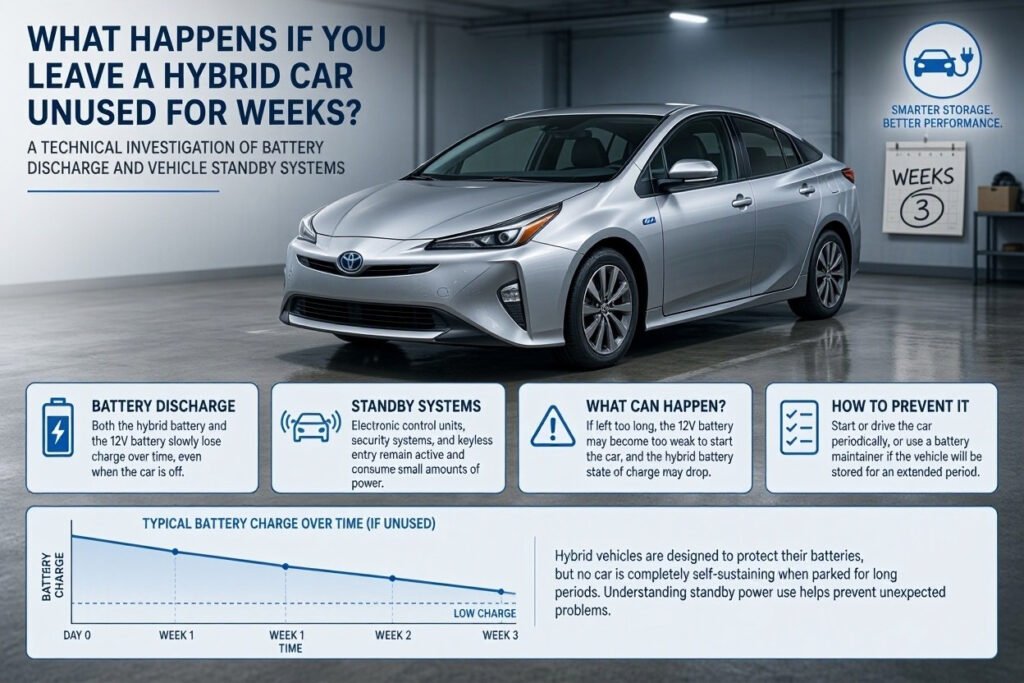
The duration of storage matters, but vehicle architecture, battery chemistry, software strategy, environmental temperature, and the manufacturer’s shutdown procedures can matter just as much.
The First Clue: Why Can a Hybrid Battery Be Charged but the Car Still Refuse to Start?
Consider a hybrid vehicle that was parked in a garage for three weeks. When its owner returns, the dashboard does not illuminate normally. The vehicle will not enter READY mode, and pressing the start button produces little or no response.
It is tempting to assume that the large hybrid battery has completely discharged. In many cases, however, the more immediate problem is the much smaller 12-volt auxiliary battery.
The distinction is fundamental.
A conventional hybrid typically contains:
- A high-voltage traction battery that supplies energy for electric propulsion and assists the gasoline engine.
- A 12-volt auxiliary battery that supports control electronics, security systems, relays, communication modules, and vehicle startup procedures.
The traction battery may still contain enough stored energy to propel the vehicle, but the car cannot necessarily access that energy until its low-voltage electronics become operational.
When the driver requests startup, control modules must initialize, verify safety conditions, communicate with the battery-management system, and coordinate the high-voltage contactors. Those contactors connect the traction battery to the vehicle’s high-voltage electrical system under controlled conditions.
If the 12-volt supply has fallen below the required operating level, the startup sequence may fail before the traction battery can be used.
This creates an important diagnostic distinction: a hybrid that refuses to enter READY mode does not automatically have a failed high-voltage battery.
The auxiliary battery may be the actual cause, even when the main battery remains reasonably charged.
The Hidden Electrical Activity Inside a Parked Vehicle
Turning off a hybrid does not necessarily disconnect every electronic component from electrical power.
Modern vehicles contain multiple modules that perform limited functions while the vehicle is parked. Depending on the design, these may include:
- Anti-theft and immobilizer systems.
- Keyless-entry receivers.
- Alarm monitoring circuits.
- Telematics and connected-vehicle equipment.
- Remote-access communication modules.
- Battery monitoring electronics.
- Door, hood, and trunk monitoring systems.
- Memory circuits and other low-power control functions.
These systems are designed to remain available without requiring the engine to operate.
Their electricity consumption is generally much lower than the power required for propulsion, but continuous consumption becomes important when a vehicle remains unused for an extended period.
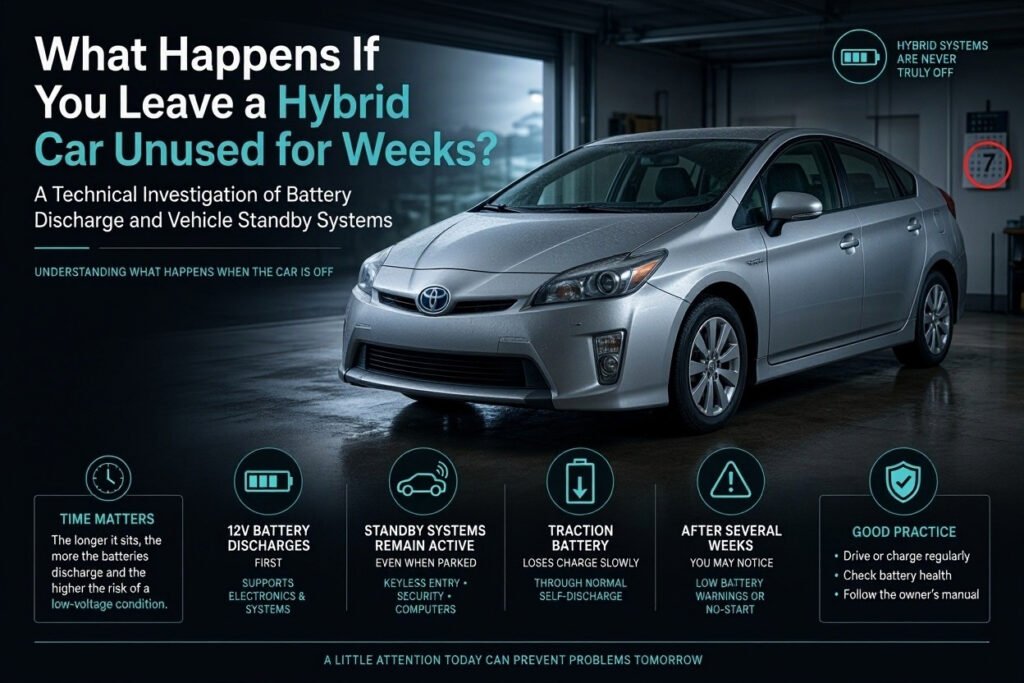
Why small electrical loads become significant over time
A battery supplies energy according to the electrical demands connected to it. Even a relatively small standby load can gradually reduce stored charge if it remains active continuously.
The relationship can be expressed simply as:
[
Q=I\times t
]
Where:
- (Q) represents the electrical charge consumed.
- (I) represents the average current drawn.
- (t) represents elapsed time.
This relationship does not establish how quickly a particular hybrid will discharge. Actual consumption depends on the vehicle’s electronics, battery capacity, operating temperature, software configuration, and whether modules successfully enter their intended sleep states.
A vehicle with well-managed standby electronics may consume very little energy. Another model with additional connected services or a communication module that remains active more frequently may have a different storage profile.
Sleep mode is not the same as complete disconnection
Vehicle manufacturers generally design control modules to enter low-power sleep states after the vehicle has been locked and left undisturbed.
However, not every system necessarily sleeps at the same moment. Some modules remain available to detect activity, receive remote commands, or monitor security conditions.
A door opening, key detection, remote application request, or other vehicle event may wake selected systems temporarily.
If repeated wake-up events occur, the auxiliary battery may experience more consumption than expected.
An aftermarket alarm, tracking device, dashcam, or incorrectly installed accessory can create additional standby demand. A fault that prevents a module from sleeping can also produce abnormal discharge.
This is why two vehicles of the same general hybrid category can behave differently during storage.
The 12-Volt Battery: The Most Vulnerable Part of Extended Parking
The auxiliary battery deserves particular attention because its capacity is much smaller than that of the traction battery, and it often supplies the electronics needed to bring the vehicle back to life.
Depending on the model, the 12-volt battery may use conventional lead-acid technology, an AGM design, or another manufacturer-specified chemistry.
Its behavior during storage depends on its condition before parking, its temperature, its age, and the vehicle’s standby electrical consumption.
Why the auxiliary battery gradually loses charge
Even when disconnected from significant electrical loads, batteries experience some degree of self-discharge. When connected to a parked vehicle, the battery may also supply energy to standby electronics.
The two effects occur simultaneously.
A healthy auxiliary battery that begins storage with an appropriate charge level may tolerate several weeks of inactivity. An older battery, a battery that was already undercharged, or one exposed to unusually demanding conditions may not.
The problem is not necessarily that hybrid technology causes excessive battery consumption. It is that a modern vehicle still depends on a relatively small low-voltage electrical supply while parked.
Why cold and heat create different problems
Temperature changes the behavior of the auxiliary battery.
In cold conditions, electrochemical reactions slow, and the battery’s ability to deliver current can become more restricted. A battery that retains some charge may consequently struggle to supply the current required for electronic initialization.
Heat creates a different concern. Elevated temperatures can accelerate battery aging and increase the rate of certain internal chemical reactions. Long-term exposure to high temperatures can shorten battery service life.
Therefore, a vehicle stored in a hot garage or outdoor parking area may experience a different battery-aging pattern from one stored in a cool, controlled environment.
The effect also depends on the battery’s existing condition. A relatively new, fully charged battery and an aging battery with reduced capacity will not respond identically to the same storage period.
What Happens to the High-Voltage Traction Battery While the Car Is Parked?
The traction battery is designed for a different job from the auxiliary battery. It stores energy for electric propulsion, engine assistance, and, in many hybrids, regenerative braking.
When the vehicle is switched off, its battery-management system generally follows a manufacturer-defined shutdown strategy. The battery is not expected to operate continuously as though the car were being driven.
Nevertheless, the pack may retain monitoring and protection functions, and its stored energy can change during an extended parking period.
Several mechanisms are involved.
Self-discharge inside the battery cells
Battery cells gradually lose stored energy through internal electrochemical processes, even when they are not supplying current to the vehicle.
This is known as self-discharge.
Its rate varies according to battery chemistry, cell design, temperature, age, and condition. Lithium-ion and nickel-metal hydride batteries do not have identical storage characteristics, so their behavior should not be treated as interchangeable.
In many hybrid vehicles, the battery-management system is designed to maintain the traction battery within an operating window rather than expose it to the full theoretical capacity of the cells.
That operating strategy can provide useful protection, but it does not mean the battery is immune to energy loss or long-term degradation.
Standby electronics and battery monitoring
Some hybrid systems retain limited battery-monitoring or protective functions while parked. Other systems minimize high-voltage activity substantially after shutdown.
The precise arrangement depends on the vehicle.
It is important not to assume that every parked hybrid continuously draws meaningful energy from its traction battery. Some of the most noticeable parked-vehicle electrical consumption may come from the 12-volt system instead.
Where the traction battery does experience a reduction in stored energy, the cause may involve internal self-discharge, vehicle-specific standby functions, or other design-dependent processes.
The battery-management system may also maintain protective limits without keeping every component continuously active.
State of Charge Is Not the Same as Battery Health
One reason owners misinterpret parked hybrid behavior is that they treat displayed battery charge as a complete measure of battery condition.
State of charge, or SOC, describes the estimated amount of energy stored in a battery relative to its usable capacity.
State of health, or SOH, describes the battery’s condition relative to its original or specified performance characteristics.
These measurements answer different questions.
A battery can have a relatively high SOC but reduced capacity because of aging. Conversely, a healthy battery can display a lower SOC after storage without having suffered permanent damage.
The distinction matters when evaluating a vehicle after several weeks of inactivity.
A temporary reduction in displayed charge does not automatically indicate that the traction battery has deteriorated.
Why the displayed charge may not tell the entire story
Hybrid battery displays often represent a managed operating range rather than the full electrochemical limits of the battery pack.
The battery-management system monitors parameters such as:
- Individual cell or module voltage, depending on system design.
- Battery current.
- Estimated state of charge.
- Battery temperature.
- Charging and discharging power limits.
- Differences between monitored cell groups.
The system uses these measurements to determine whether the battery can safely accept or deliver energy.
For example, a battery may have an acceptable SOC but temporarily restricted output because its temperature is too low or too high.
Similarly, a battery approaching an upper voltage limit may have less available charging headroom.
These conditions can influence how the vehicle behaves after it returns to service, even when the battery has not developed a fault.
Temperature Can Change Battery Behavior Without Any Driving
A parked vehicle is still exposed to its surrounding environment.
The traction battery does not necessarily remain at the temperature it had when the owner switched off the vehicle. Over time, its temperature moves toward the conditions surrounding the vehicle, although enclosure design, thermal insulation, cooling arrangements, and storage location influence the process.
This creates two distinct concerns: energy-storage behavior and available electrical performance.
Cold storage and restricted battery performance
Low temperatures can increase internal resistance in many battery chemistries.
Internal resistance affects how much terminal voltage changes when current flows through a battery.
A simplified relationship is:
[
V_{\text{terminal}}=V_{\text{open circuit}}-IR
]
Where:
- (V_{\text{terminal}}) is the voltage measured while current is flowing.
- (V_{\text{open circuit}}) is the battery’s voltage without a load.
- (I) is the current.
- (R) represents internal resistance.
As internal resistance increases, a given electrical demand can produce a larger voltage drop.
The battery-management system may respond by restricting available discharge power or charging power to protect the cells.
After an extended period in cold conditions, a hybrid may therefore feel less electrically responsive until the battery reaches a more favorable operating temperature.
This does not necessarily indicate permanent damage.
The actual limits depend on chemistry, temperature, battery design, and manufacturer calibration.
Heat exposure and long-term battery aging
High temperatures create a different set of concerns.
Elevated cell temperatures can accelerate unwanted chemical reactions inside many rechargeable batteries. Over time, this can contribute to capacity loss and increased internal resistance.
A parked vehicle exposed to intense sunlight may develop high cabin and component temperatures, particularly when ventilation is limited.
Some hybrids use dedicated traction-battery cooling arrangements, but the presence of a cooling system does not guarantee active temperature control while the vehicle is switched off.
Cooling strategies vary significantly by manufacturer and architecture.
Owners should not assume that a parked hybrid will continuously operate its cooling fan or thermal-management equipment to maintain ideal battery temperature.
HEVs and PHEVs: Why Extended Storage Is Not Identical
The distinction between a conventional hybrid electric vehicle and a plug-in hybrid becomes especially important when the vehicle is left unused.
Both use an internal combustion engine and an electric propulsion system, but their battery capacities, charging arrangements, and energy-management strategies differ.
Conventional hybrids: A managed operating window
A conventional HEV generally maintains its traction battery within a relatively controlled operating range.
The engine, motor-generators, and regenerative braking system work together to maintain the battery’s available energy during normal driving.
Because the driver usually cannot charge the traction battery directly from an external power source, the vehicle manages energy through fuel consumption and recovered braking energy.
During extended parking, the battery remains subject to its own self-discharge characteristics and any vehicle-specific standby consumption.
However, the larger practical concern for many conventional hybrids may still be the 12-volt auxiliary battery.
If that battery becomes too weak to initialize the vehicle, the owner may be unable to access the propulsion system even though the traction battery retains useful energy.
Plug-in hybrids: More stored energy, different storage decisions
A PHEV generally has a larger traction battery and can receive energy from an external charger.
This provides greater electric-driving capability, but it introduces another storage consideration: the SOC at which the vehicle is left parked.
A plug-in hybrid left with a very high or very low battery charge may experience different long-term storage conditions from one stored at the manufacturer’s recommended charge level.
Battery chemistry matters here.
Many lithium-ion battery designs experience greater long-term aging stress when stored for extended periods at high SOC, particularly when combined with elevated temperature. Very low charge can also be undesirable because continued energy loss may eventually approach protective lower-voltage limits.
The appropriate storage charge level is not universal. It depends on the battery chemistry, vehicle software, manufacturer strategy, and intended storage duration.
A PHEV owner should therefore follow the specific storage guidance in the owner’s manual rather than assume that leaving the car fully charged is always best.
Should a PHEV remain plugged in?
There is no universal answer.
Some manufacturers provide a defined long-term storage procedure involving a particular charge range or charging arrangement. Others may specify different instructions depending on the model.
A vehicle’s onboard charging system may include functions intended to manage battery conditions while connected to an external power source, but this should not be assumed to apply to every PHEV.
Leaving a plug-in hybrid connected indefinitely without checking the manufacturer’s instructions is not a substitute for understanding its storage requirements.
The correct approach is model-specific.
Why Battery Chemistry Changes the Storage Equation
Not all hybrid traction batteries use the same chemistry.
Two common categories are nickel-metal hydride and lithium-ion.
Their storage behavior, voltage characteristics, temperature sensitivity, and self-discharge patterns differ.
Nickel-metal hydride batteries
Nickel-metal hydride batteries have been used extensively in conventional hybrid vehicles.
They are designed for repeated charging and discharging, and their operating strategies are adapted to the characteristics of the chemistry.
Their self-discharge behavior can differ from that of lithium-ion cells, and temperature can influence both charge retention and performance.
A vehicle using this battery type may therefore respond differently to prolonged storage than a lithium-ion PHEV.
Lithium-ion batteries
Lithium-ion batteries are common in plug-in hybrids and many newer hybrid designs.
Their long-term storage characteristics depend on cell chemistry, SOC, temperature, and age.
High storage temperatures and prolonged exposure to high SOC can increase aging stress in many lithium-ion designs.
At the other end of the charge range, a battery that experiences continued discharge while already at a low SOC may eventually reach protective limits.
Battery-management systems are designed to reduce these risks, but their protection strategy does not eliminate the need to follow the manufacturer’s storage recommendations.
The important point is that a battery’s behavior cannot be predicted from the word hybrid alone. Chemistry and vehicle design both matter.
What Happens When the Vehicle Is Finally Switched On?
After several weeks of inactivity, the vehicle must move from its parked electrical state into its normal operating state.
This transition involves more than pressing the start button.
The low-voltage electrical system must supply the control modules. The vehicle must verify relevant safety conditions, communicate with the battery-management system, and establish the required high-voltage connections.
If these processes complete successfully, the vehicle enters READY mode.
The gasoline engine may start immediately, remain off, or operate later depending on battery charge, temperature, cabin-heating requirements, emissions controls, and the vehicle’s energy-management strategy.
A silent engine after READY does not necessarily indicate a problem. Many hybrids can begin operating electrically under suitable conditions.
Why the engine may run more frequently after storage
A vehicle that has been parked for weeks may initially operate differently from how its owner remembers it.
The engine might run to satisfy battery-management requirements, warm up the powertrain, provide cabin heat, or meet emissions-system conditions.
In a PHEV, the vehicle may also select an engine-assisted operating mode depending on temperature, power demand, and its control strategy.
These changes can be normal.
The engine’s initial operating pattern should not be confused with proof that the traction battery has been damaged.
The system is responding to its current operating conditions, not simply reproducing the behavior it had before storage.
Normal Storage Effects or a Genuine Electrical Fault?
Not every battery-related issue after extended parking represents a failure. At the same time, persistent problems should not be dismissed as ordinary self-discharge.
The distinction becomes clearer when the symptoms are examined in context.
| Observed behavior | Possible explanation | What it suggests |
|---|---|---|
| Dashboard remains dark | Weak or depleted 12-volt battery | Low-voltage supply may be unable to initialize the vehicle |
| Dashboard illuminates but READY does not appear | Low auxiliary voltage, safety interlock, or system fault | Startup sequence requires diagnosis |
| Traction battery display is lower | Storage-related charge loss or changed SOC estimate | Does not automatically indicate battery damage |
| Engine runs more often initially | Warm-up, charging strategy, or temperature management | May be normal operating behavior |
| Electric power feels temporarily restricted | Battery temperature or power-limit protection | May improve when conditions become suitable |
| Hybrid warning remains illuminated | Possible battery, inverter, sensor, or control-system fault | Requires model-appropriate diagnostic assessment |
A single observation rarely identifies the exact cause.
For example, a low battery display could reflect a genuine reduction in stored energy, a change in the estimated SOC, or a control strategy that has temporarily adjusted the usable operating range.
A persistent warning, repeated failure to enter READY, abnormal electrical behavior, or a battery that repeatedly becomes depleted after short storage periods deserves further investigation.
Diagnostic trouble codes and manufacturer-specific live data can help distinguish a weak auxiliary battery from a traction-battery, charging, or control-system problem.
Owners should avoid opening high-voltage battery enclosures or attempting to diagnose internal traction-battery components themselves.
Why Some Hybrids Tolerate Weeks of Parking Better Than Others
The difference between two parked hybrids is not determined solely by battery capacity.
A vehicle’s storage performance reflects several systems working together:
Low-voltage architecture: The 12-volt battery’s chemistry, capacity, age, and standby load determine how much reserve remains available for startup.
Electronic sleep strategy: The way control modules enter sleep mode influences how much electricity the vehicle consumes while parked.
Connected services: Remote access, telematics, security equipment, and aftermarket accessories can introduce additional electrical demands.
Traction-battery chemistry: Different cell chemistries have different self-discharge and temperature characteristics.
Thermal design: Battery enclosure, ventilation, cooling arrangements, and environmental exposure influence storage conditions.
Software calibration: Manufacturers determine how battery charge, voltage, temperature, and protective limits are managed.
Vehicle condition: An aging auxiliary battery, deteriorated electrical connection, parasitic drain, or existing fault can make a vehicle less tolerant of extended inactivity.
This explains why a hybrid that remains reliable after a month in controlled indoor storage may experience difficulties after a shorter period in a hot outdoor environment.
The storage period is only one part of the engineering picture.
Manufacturer Storage Recommendations Are More Important Than Generic Rules
Hybrid manufacturers may provide specific instructions for vehicles that will remain unused for an extended period.
Those instructions can address auxiliary-battery charging, traction-battery SOC, external charging, vehicle shutdown procedures, and the recommended frequency of operation.
They may also distinguish between ordinary parking and long-term storage.
The differences are important because a procedure intended for one hybrid battery system may be inappropriate for another.
For example, an instruction to maintain a particular charge level in a PHEV should not automatically be applied to a conventional HEV. Likewise, a recommendation involving an approved battery maintainer must not be interpreted as permission to connect an arbitrary charger to the vehicle’s high-voltage system.
If the owner’s manual specifies a particular storage method, that guidance takes priority over general advice.
Where the vehicle will remain unused for a substantial period, the manufacturer’s recommended procedure should be followed rather than relying on assumptions about how long a hybrid battery ought to last.
A Parked Hybrid Is Still a Managed Electrical System
Leaving a hybrid car unused for several weeks does not automatically damage its traction battery, nor does it guarantee that the vehicle will restart without difficulty.
The most important distinction is between the auxiliary battery and the high-voltage traction battery. The auxiliary battery can become too weak to initialize the vehicle even while the larger battery retains useful stored energy. Meanwhile, the traction battery experiences its own chemistry-dependent self-discharge, temperature effects, and manufacturer-controlled storage limits.
An HEV and a PHEV also face different storage considerations. Conventional hybrids generally maintain a managed traction-battery operating window, while plug-in hybrids introduce additional questions about external charging and the SOC at which the vehicle is stored.
The vehicle’s electronic sleep strategy, battery chemistry, ambient temperature, existing battery condition, and connected equipment all influence the outcome.
A hybrid is engineered to manage energy during both driving and periods of inactivity. But that management has limits. Understanding those limits explains why a car can sit quietly in a garage for weeks and still develop an electrical problem without ever turning its engine on.