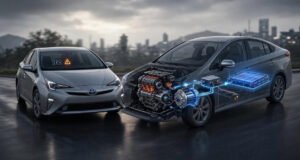
A hybrid vehicle has an advantage that a conventional gasoline car cannot easily match: it can draw on two different sources of power and decide how to use them as driving conditions change. One source is gasoline, which powers an internal combustion engine. The other is electricity stored in a battery and delivered through an electric motor.
But how does a hybrid vehicle use two power sources without wasting fuel or making the driving experience complicated? The answer lies in how the vehicle controls energy. Instead of forcing the gasoline engine to handle every movement, the hybrid system assigns different tasks to the engine and electric motor, sometimes using both together.
This arrangement becomes particularly useful in traffic, during acceleration, and when slowing down. Understanding the process also helps buyers distinguish genuine hybrid benefits from claims that every hybrid works in exactly the same way.

1. Two Sources of Power, One Coordinated System
The gasoline engine and electric motor are not independent systems competing to move the car. They work under the direction of an electronic control system that manages the flow of energy.
The gasoline engine burns fuel to create mechanical power. The electric motor converts electrical energy from the battery into mechanical power. Depending on the vehicle’s design, either source can move the wheels under suitable conditions, or both can contribute simultaneously.
Several components make this possible:
- Gasoline engine: Produces mechanical power by burning fuel.
- Electric motor: Drives the wheels or assists the engine.
- Hybrid battery: Stores electricity for electric propulsion and assistance.
- Power electronics: Regulate electrical energy flowing between the battery and motor.
- Control computer: Decides how the available power sources should operate.
- Transmission or power-split mechanism: Transfers power through the drivetrain.
- Regenerative braking system: Recovers some energy when the vehicle slows down.
The exact arrangement varies between models, but the objective remains similar: provide the required driving power while using energy as efficiently as practical.
2. The First Power Source: How Gasoline Moves the Vehicle
A hybrid’s gasoline engine operates on the same fundamental principle as an engine in a conventional car.
Fuel burns inside the cylinders, creating pressure that moves pistons. The pistons turn a crankshaft, producing mechanical power. That power can then reach the wheels through the transmission or drivetrain.
In some hybrid designs, the engine can also supply mechanical energy to a generator that produces electricity.
Why keep a gasoline engine if electricity can move the car? Because gasoline provides substantial stored energy, and the engine can be useful for sustained driving, high power demands, and longer journeys.
When climbing a steep road or travelling at highway speeds, the engine may supply most of the power. Its role depends on the drivetrain, vehicle speed, battery condition, and the driver’s demands.
The gasoline engine is not necessarily running every time the vehicle moves. That flexibility is one of the central advantages of hybrid technology.
3. The Second Power Source: What the Electric Motor Contributes
The electric motor gives a hybrid a different way to produce movement.
Electricity flows from the battery through power electronics to the motor. The motor converts that electrical energy into torque, which can turn the wheels directly or assist the engine.
One major advantage is the motor’s ability to deliver useful torque from very low speeds. This makes it valuable when a car starts moving from rest or accelerates away from a traffic light.
In a full hybrid, the motor may propel the vehicle without the gasoline engine running, provided the battery has enough usable charge and conditions permit. In other situations, it supplements engine power.
The motor can also operate as a generator during regenerative braking, helping return some energy to the battery.
However, an electric motor cannot provide unlimited power. Its contribution depends on its capacity, battery output, temperature, and the vehicle’s control strategy.
4. How the Two Power Sources Work Together During Acceleration
Imagine joining a busy road from a side street. The car initially moves slowly, then you press the accelerator to merge into faster traffic.
The electric motor can provide the initial torque. As your requested acceleration increases, the gasoline engine may start and contribute additional power.
In many hybrids, both sources can work together, helping the vehicle accelerate without requiring the engine to handle every demand alone.
The way this happens depends on the drivetrain.
A parallel hybrid can combine mechanical power from the engine and electric motor. A series hybrid uses an engine-driven generator to produce electricity while the electric motor drives the wheels. A series-parallel hybrid can use different power paths according to operating conditions.
These designs achieve a similar broad goal through different engineering arrangements. There is no single mechanical layout used by every hybrid vehicle.
5. Why the Vehicle Sometimes Uses Electricity Alone
Electric-only driving is most useful when the vehicle needs relatively little power and the operating conditions are suitable.
For example, a full hybrid may move through a parking area, creep through slow traffic, or travel a short distance on electric power. The gasoline engine can remain off during these situations.
The benefit is that the engine does not need to burn gasoline for every small movement.
However, electric-only operation is not guaranteed. The engine may start when the battery charge is low, the vehicle requires strong acceleration, cabin heating demands additional energy, or the engine needs to warm up.
Mild hybrids are different: their electric systems generally assist the gasoline engine but cannot independently drive the vehicle.
This distinction is important when comparing specifications or deciding whether a hybrid suits your daily driving needs.
6. How Regenerative Braking Adds Energy Back to the System
The two power sources do not tell the whole story. A hybrid can also recover some energy that would otherwise be wasted when the vehicle slows down.
In a conventional car, friction brakes convert much of the vehicle’s kinetic energy into heat. In a hybrid, the electric motor can act as a generator during deceleration.
As the moving wheels drive the motor-generator, some mechanical energy becomes electricity. The battery stores that electricity for later use.
When the driver accelerates again, the stored energy can help power the electric motor, reducing the amount of work that must be supplied by gasoline.
This process is called regenerative braking.
It is not a source of free energy, and it cannot recover everything the car loses. Some energy disappears through air resistance, tire friction, heat, and electrical conversion losses. The conventional braking system also remains essential.
7. How the Control System Chooses the Right Source
A hybrid’s computer continually assesses how much power the vehicle needs and what resources are available.
It considers information such as:
- Vehicle speed and accelerator position.
- Battery charge and temperature.
- Engine temperature and operating conditions.
- Road gradient and acceleration demand.
- Heating, air conditioning, and other electrical loads.
If the driver accelerates gently, the electric motor may handle much of the work. If stronger acceleration is required, the engine can start and assist. During steady cruising, the engine may provide most of the driving power, depending on the design.
When the driver brakes, the system may switch the motor into generator mode and recover energy.
These changes generally occur automatically. The driver does not need to calculate which power source is best at every moment.
8. Does Using Two Power Sources Always Save Fuel?
Not automatically. The advantage comes from how effectively the vehicle manages energy, not simply from having two systems.
Hybrids can reduce unnecessary idling, use electric assistance during acceleration, and recover some braking energy. These features can be especially helpful in stop-and-go city traffic.
On long highway journeys, regenerative braking opportunities may be less frequent, and the gasoline engine may provide most of the power. The fuel-economy advantage therefore depends on the vehicle and driving conditions.
Aggressive acceleration, high speeds, cold weather, low tire pressure, and heavy loads can also reduce efficiency.
A hybrid buyer should compare the vehicle’s expected fuel consumption, purchase price, maintenance costs, and typical driving conditions rather than assuming that every hybrid will deliver the same savings.
9. What Owners Should Know About Maintenance
Both power sources require appropriate care. The gasoline engine still needs scheduled servicing, suitable oil, filters, and inspections. The hybrid battery, power electronics, cooling systems, brakes, tires, and auxiliary 12-volt battery also matter.
Before buying a used hybrid, review its service history and consider a professional inspection of the hybrid system. A standard diagnostic scanner may not support every battery or hybrid-system test, so verify compatibility before purchasing one.
Do not attempt to inspect or repair high-voltage components without the appropriate training and equipment.
The Final Answer: Why Two Power Sources Make a Difference
A hybrid vehicle uses gasoline and electricity as complementary sources of power. The engine supplies mechanical energy when needed, the electric motor drives or assists the vehicle when conditions permit, and regenerative braking recovers some energy during deceleration.
The control system coordinates these functions according to driving demand and available energy. This allows the vehicle to reduce certain energy losses while retaining the convenience and range of a gasoline-powered car.
The real advantage is not that the hybrid always chooses electricity. It is that the vehicle can choose a suitable combination of power sources for the task at hand.
Amazon Affiliate Product Suggestions
The following five product categories are relevant to readers interested in hybrid vehicle operation, monitoring, and maintenance. These are Amazon search links rather than verified individual product listings. Always check the vehicle compatibility and supported functions before recommending a product.
| Product | Why It Is Relevant | Amazon Search Link |
|---|---|---|
| Hybrid-compatible OBD2 scanner | Reads supported engine fault codes and vehicle information | Search on Amazon |
| Digital tire pressure gauge | Helps maintain correct tire pressure and reduce unnecessary rolling resistance | Search on Amazon |
| 12V car battery tester | Checks the auxiliary battery separately from the high-voltage hybrid battery | Search on Amazon |
| Hybrid vehicle repair manual | Provides model-specific servicing and troubleshooting information when available | Search on Amazon |
| Portable tire inflator | Helps drivers maintain suitable tire pressure while travelling | Search on Amazon |