A hybrid car can accelerate normally for several minutes, then suddenly feel as though someone has taken away a substantial portion of its power. The accelerator remains responsive, but the vehicle struggles to gain speed. In another situation, the power reduction occurs while climbing a hill, accelerating onto a highway, or driving in extreme heat. Sometimes a warning message appears immediately; in other cases, the driver notices a dramatic change in performance before any obvious explanation is displayed.
The cause is not necessarily a failing engine or an exhausted hybrid battery. A hybrid powertrain continuously calculates how much power its electrical and mechanical components can safely deliver. If the battery, inverter, electric motor, engine, fuel system, or cooling system cannot meet the requested demand, the control system may reduce available output.
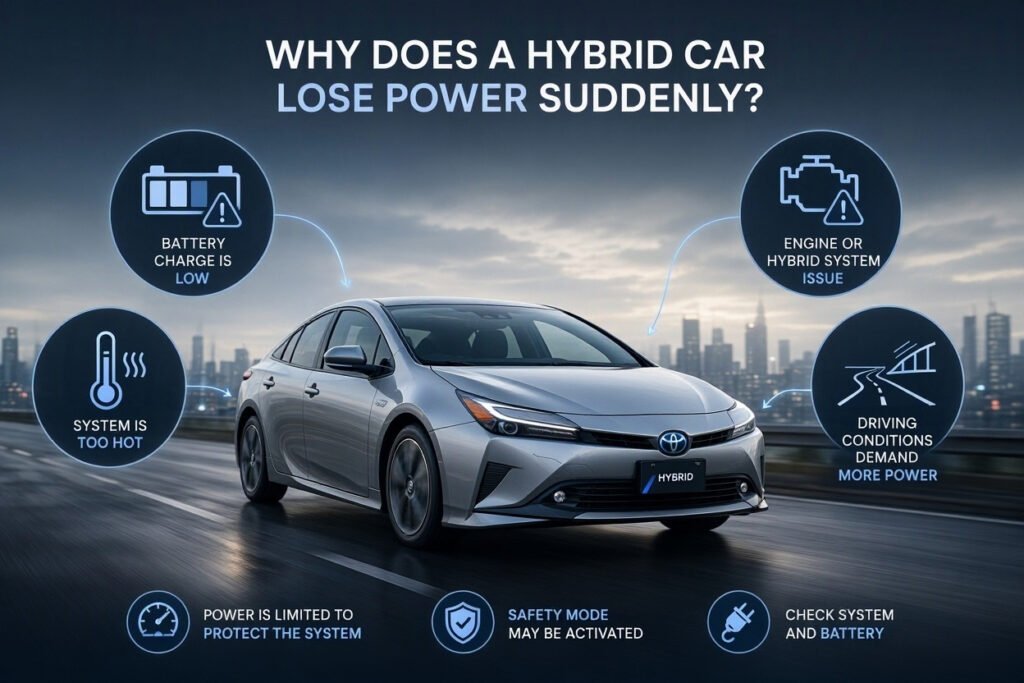
Understanding why a hybrid car loses power suddenly requires distinguishing between a temporary protective response and a genuine mechanical or electrical fault. It also requires separating gradual performance deterioration from an abrupt loss of propulsion, because those two patterns can point toward different underlying problems.
The First Clue: Why Does Power Disappear When the Battery Still Shows Charge?
One of the most confusing hybrid driving experiences occurs when the dashboard shows a reasonable battery charge level, yet the vehicle suddenly becomes less responsive.
A driver may assume that a battery with visible charge should be capable of delivering normal electric assistance. However, the displayed state of charge (SOC) does not reveal the battery’s complete ability to supply power at that moment.
Stored energy and available power are different measurements
SOC estimates how much usable energy remains in the battery. Power capability describes how quickly the battery can deliver or accept electrical energy.
A battery can contain substantial stored energy while being temporarily unable to deliver the current required for strong acceleration.
The battery management system (BMS) evaluates several conditions before allowing the battery to supply propulsion power:
- Individual cell or module voltage.
- Battery temperature.
- Charging and discharging current.
- Estimated state of charge.
- Internal resistance and voltage response.
- Cell imbalance and operating limits.
These measurements help the BMS establish a permitted power envelope. The hybrid control system uses that information when deciding how much assistance the electric motor can provide.
If the available battery power falls below the level required for the driver’s accelerator request, the vehicle may reduce acceleration even though the battery display does not appear empty.
Why cell voltage matters during acceleration
When a hybrid accelerates, the battery may need to deliver substantial current to the inverter and electric motor.
As current flows, internal resistance produces a voltage drop within the battery. A simplified relationship is:
[
V_{\text{terminal}}=V_{\text{open circuit}}-IR
]
Here, (I) represents current and (R) represents internal resistance.
The actual battery behavior is more complex, but the relationship illustrates why a battery’s voltage can fall under heavy load.
If one weak cell or module approaches its lower voltage limit before the rest of the pack, the BMS may restrict discharge power to protect it.
This can produce a sudden reduction in electric assistance.
The overall battery may still show an acceptable SOC, but one part of the pack may be limiting the power available from the entire system.
Temperature can change the power available
Battery temperature influences electrochemical activity and internal resistance.
At low temperatures, cells generally become less responsive, and internal resistance can increase. This can reduce the power available for acceleration.
At high temperatures, the BMS may limit current to control heat generation and protect battery life.
A hybrid climbing a long grade in hot weather may therefore experience reduced electric assistance even if its battery initially appeared fully functional.
These conditions do not automatically indicate permanent battery failure. A temporary restriction caused by temperature or operating limits is different from a persistent fault involving abnormal cell voltage, sensor readings, or battery imbalance.
What Happens When the Inverter Cannot Deliver the Requested Power?
The battery does not supply the electric motor directly. Electrical energy passes through power electronics, especially the inverter, before reaching the motor in the form required for operation.
The inverter is therefore one of the most important components in the hybrid powertrain’s ability to produce acceleration.
Converting battery power into motor torque
A traction battery generally supplies direct-current (DC) electricity. The inverter converts and controls this electrical energy to operate the electric motor.
It regulates the motor’s electrical input according to commands from the hybrid control system.
Depending on the design, the inverter may also manage electrical energy flowing back from the motor during regenerative braking.
This makes it a critical link between battery availability and actual wheel torque.
If the inverter cannot safely handle the requested electrical load, the control system may reduce motor output or disable part of the electric propulsion system.
Why inverter temperature can cause sudden power reduction
Power electronics generate heat during operation. Semiconductor switching losses, electrical resistance, and other internal losses contribute to thermal loading.
The inverter uses cooling arrangements designed to keep its components within permitted temperature ranges. Depending on the vehicle, cooling may involve a dedicated liquid circuit, shared thermal-management components, or another manufacturer-specific arrangement.
If cooling performance becomes inadequate, component temperatures may rise.
Possible contributing conditions include:
- Low coolant level in the relevant circuit.
- Restricted coolant circulation.
- A malfunctioning electric coolant pump.
- A blocked or inefficient heat exchanger.
- A cooling fan problem.
- Excessive ambient temperature or sustained power demand.
- Faulty temperature sensing.
When thermal limits approach, the control system can reduce current and motor output to protect semiconductor components.
The driver may experience weaker acceleration, a hybrid-system warning, or a restricted-power operating mode.
Why an inverter fault can look like a battery problem
The driver experiences the result at the wheels, not inside the power electronics.
If the inverter reduces motor torque, the vehicle may feel as though the battery has lost power. Yet the battery could be functioning normally.
This is why replacing a traction battery based only on poor acceleration is not a reliable diagnostic approach.
Technicians need to examine inverter temperature data, coolant-system performance, current measurements, fault codes, and communication between the relevant control modules.
The Electric Motor: When Torque Production Becomes the Limiting Factor
A hybrid’s electric motor can provide strong torque, particularly during initial acceleration. However, motor output depends on electrical supply, temperature, rotational speed, and control limits.
A motor that cannot produce its expected torque may cause a noticeable reduction in acceleration even when the engine remains operational.
Electrical and thermal restrictions
The motor produces torque through electromagnetic interaction between its stator and rotor.
Its controller regulates current to create the required magnetic fields. Higher torque generally requires greater electrical current within the motor’s operating range.
Sustained high current produces heat in the windings and other components.
If temperatures become excessive, the control system may reduce current to protect insulation, permanent magnets where fitted, and other motor components.
A motor can therefore lose available torque without experiencing a complete electrical failure.
Motor speed also affects available output
Electric motors do not provide identical torque at every rotational speed.
Their operating characteristics depend on motor design, voltage, current limits, magnetic-field control, and inverter capability.
At certain speeds, available torque may decline even though the motor remains within its normal operating range.
This matters when a driver interprets reduced acceleration at highway speed as a fault. Some reduction may reflect the normal power characteristics of the hybrid system, while an abrupt and unusual change may indicate a fault or protective limitation.
The distinction depends on the vehicle’s design and whether warning messages or abnormal operating behavior accompany the change.
The Gasoline Engine May Be the Missing Half of the Powertrain
Hybrid power is not always available from the electric motor alone. In many driving situations, the gasoline engine supplies a substantial portion of the requested propulsion power.
If the engine cannot produce its expected output, the vehicle may feel dramatically weaker even when the electrical system is functioning correctly.
Engine power reduction under mechanical or combustion faults
A hybrid engine remains an internal combustion engine. It depends on correct air delivery, fuel supply, ignition, compression, lubrication, and thermal control.
Several engine-related problems can reduce available power:
- Restricted air intake.
- Faulty airflow or pressure sensors.
- Ignition misfires.
- Fuel-pressure problems.
- Injector malfunction.
- Exhaust restriction.
- Abnormal engine temperature.
- Mechanical damage or loss of compression.
The engine control module monitors operating conditions and may reduce engine output when it detects a problem that threatens emissions compliance, component protection, or safe operation.
Some faults produce gradual deterioration. Others can trigger an abrupt transition into a restricted operating mode.
Why engine problems can feel different in a hybrid
A conventional gasoline vehicle depends primarily on its engine for propulsion. A hybrid has an electric motor that may temporarily compensate for reduced engine output.
This can make some engine problems less obvious at first.
For example, a hybrid may still accelerate using electric assistance even when the engine is producing less power than expected.
However, if the electrical system cannot supply enough additional torque, the loss of engine output becomes much more noticeable.
The driver may experience weak acceleration, unusual engine behavior, or a warning message when the system can no longer maintain the expected combined power.
Fuel Delivery: Why an Engine Can Suddenly Stop Supporting Acceleration
Fuel-system problems deserve particular attention when power loss occurs during acceleration or under sustained load.
An engine may idle normally but fail to produce adequate power when the driver demands more output.
Fuel pressure and delivery capacity
The fuel pump must deliver gasoline at the pressure and flow rate required by the engine.
If the pump becomes weak, a filter or line becomes restricted where applicable, or a pressure-control component malfunctions, fuel delivery may become inadequate under higher demand.
The engine may then experience:
- Hesitation during acceleration.
- Misfires under load.
- Unstable engine operation.
- Reduced torque.
- Engine warning indicators.
- A protective reduction in power.
A fuel-pressure sensor or related electrical fault can also produce misleading symptoms.
The control system may respond to an implausible signal even when the mechanical fuel-delivery components are not the original cause.
Why fuel problems can trigger a hybrid power reduction
When the engine cannot produce the expected power, the hybrid controller may attempt to increase electric assistance.
However, the battery and electric motor have their own output limits.
If battery SOC is low, cell temperature is unfavorable, or the inverter is already thermally restricted, the electric system may not be able to compensate.
The combined result can be a sudden loss of acceleration.
This illustrates an important feature of hybrid powertrain diagnosis: a problem originating in one subsystem can become more noticeable because another subsystem cannot compensate for it.
Gradual Performance Reduction Versus Abrupt Power Loss
The way power disappears can help narrow the investigation.
A vehicle that gradually becomes weaker over several minutes presents a different diagnostic pattern from one that suddenly loses acceleration or enters a restricted mode.
Gradual reduction: A changing operating limit
Gradual performance deterioration may occur when a component approaches a thermal or electrical limit.
Examples include:
- Battery temperature gradually increasing under sustained demand.
- Inverter cooling becoming less effective.
- Motor temperature rising during repeated high-load operation.
- Battery SOC declining during prolonged acceleration or climbing.
- Engine output becoming restricted as temperature rises.
In these situations, the control system may progressively reduce permitted power.
The vehicle may still operate, but acceleration becomes less responsive.
If the limiting condition is temporary, performance may improve after the system cools or battery conditions return to an acceptable range.
Abrupt power loss: A fault or protective transition
A sudden change can occur when a sensor detects a fault, a control module receives an abnormal signal, or a component crosses a protection threshold.
Potential causes include:
- A high-voltage isolation fault.
- An inverter or motor electrical fault.
- A battery-management protection event.
- Sudden fuel-pressure loss.
- Severe engine misfire.
- A failed sensor or control circuit.
- A communication problem between powertrain modules.
The vehicle may immediately restrict output or disable some propulsion functions.
An abrupt loss of power should not be dismissed as normal hybrid behavior, particularly if it occurs with warning messages, unusual noises, smoke, overheating, or an inability to maintain a safe speed.
Why Driving Conditions Often Reveal the Underlying Problem
The circumstances in which power loss occurs can provide valuable diagnostic evidence.
The same vehicle may perform normally during light urban driving but lose power during highway acceleration or a long uphill climb.
That difference can indicate that a component is struggling under sustained demand.
Uphill driving and prolonged high load
Climbing a grade increases the power required to maintain speed.
The engine, electric motor, inverter, and battery may all contribute more heavily than they would on level ground.
If the battery is cold, nearly depleted, or thermally restricted, the electrical system may provide less assistance.
If the engine has a fuel-delivery or airflow problem, the vehicle may struggle to maintain speed.
If inverter or motor cooling is inadequate, sustained electrical demand may trigger thermal power reduction.
The location and timing of the power loss are therefore useful clues.
Highway acceleration
Accelerating from an already high cruising speed requires substantial power, particularly when aerodynamic drag is significant.
The hybrid system may request additional engine output and electric assistance.
If one subsystem cannot provide its expected contribution, the driver may notice hesitation or reduced acceleration.
A sudden loss of power during highway driving is particularly important because it can affect the driver’s ability to merge, pass, or maintain a safe traffic speed.
Repeated acceleration and high ambient temperatures
Repeated acceleration can create sustained thermal loading in the battery, inverter, and electric motor.
Hot weather can make it harder for cooling systems to remove that heat.
A vehicle that behaves normally during a short trip may therefore reduce power after prolonged high-load operation.
However, repeated thermal restrictions should not automatically be considered normal. Poor coolant circulation, low coolant, a failed pump, or a malfunctioning fan may be contributing to the problem.
What Warning Messages Reveal About the Powertrain
A warning message is not simply an instruction to visit a repair shop. It can help identify which control system has detected an abnormal condition.
The exact wording varies by manufacturer, but messages involving the hybrid system, battery, engine, inverter, or reduced power can indicate different diagnostic paths.
For example:
| Warning or symptom | Possible area of investigation |
|---|---|
| Hybrid-system warning | Battery, inverter, motor, contactors, control modules, or related wiring |
| Reduced-power message | Protective output limitation caused by an electrical, thermal, or engine condition |
| Engine warning light | Engine-management, ignition, fuel, emissions, or sensor fault |
| Battery-temperature warning | Battery cooling, temperature sensing, or thermal operating limits |
| Inverter or electrical-system warning | Power electronics, cooling circuit, wiring, or control faults |
| High engine temperature | Engine cooling system or thermal-management problem |
These are diagnostic directions, not definitive component diagnoses.
A warning that mentions the battery does not prove that the battery pack itself has failed. A cooling-system problem, sensor fault, or wiring issue may produce a related warning.
The control system’s stored information is needed to identify the actual cause.
Diagnostic Trouble Codes: Why the First Code Is Not Always the Root Cause
Modern hybrid vehicles use multiple electronic control modules that monitor different parts of the powertrain.
When a fault occurs, one or more modules may store diagnostic trouble codes (DTCs).
These codes can identify the system that detected abnormal behavior, the conditions under which it occurred, and sometimes the operating data associated with the event.
Why generic code readers may provide incomplete information
A basic scan tool may retrieve engine-related codes but fail to access all hybrid-specific modules.
Important information may be stored in the battery management system, inverter controller, hybrid control unit, transmission controller, or other electronic systems.
A complete diagnosis may require manufacturer-capable equipment that can retrieve:
- Hybrid-system trouble codes.
- Battery voltage and temperature data.
- Battery current and SOC information.
- Inverter and motor temperature readings.
- Cooling-system operating information.
- Engine fuel and airflow data.
- Freeze-frame or event-related information.
- Communication faults between modules.
A code identifies a detected condition, not automatically a failed part
A diagnostic code related to inverter temperature, for example, does not prove that the inverter itself is defective.
The underlying cause might involve coolant circulation, a temperature sensor, wiring, or a control issue.
Likewise, a battery-related code may originate from a weak cell, an electrical connection, a sensor, or a problem in the battery monitoring circuit.
Replacing a major component without investigating the complete fault path can lead to unnecessary expense and leave the original problem unresolved.
Why Hybrid Architecture Changes the Way Power Loss Develops
Different hybrid designs distribute propulsion duties differently, so their symptoms may not be identical.
Parallel hybrids can combine engine and electric-motor torque through a mechanical drivetrain. If either source becomes restricted, the other may provide some compensation, depending on available power and control strategy.
Series hybrids rely on electric motors for wheel propulsion, while the engine primarily supplies electrical energy through a generator. An engine or generator problem can therefore affect the electrical energy available to the traction system.
Power-split hybrids use a combination of mechanical and electrical power paths, often coordinated through a planetary gearset and motor-generators. Engine speed, motor torque, and battery power are managed together.
Plug-in hybrids (PHEVs) generally have larger traction batteries and greater electric-driving capability than conventional hybrids. However, they can still experience reduced propulsion if battery power, inverter capacity, motor temperature, or engine operation becomes restricted.
Mild hybrids usually provide less independent electric propulsion. Their electric system primarily assists the combustion engine, so an engine-performance problem may have a more direct effect on overall driving capability.
Battery chemistry also influences the details of power limitation. Lithium-ion and nickel-metal hydride systems have different voltage, thermal, and charge-management characteristics. Both require monitoring and protective limits, but their specific operating strategies are manufacturer-dependent.
What to Do When a Hybrid Suddenly Loses Power
The immediate priority is vehicle control and road safety, not identifying a failed component while driving.
If power drops unexpectedly, avoid aggressive acceleration attempts. Move to a safe location when possible, use hazard warning lights if necessary, and follow the vehicle’s instructions.
If the vehicle displays an overheating warning, a high-voltage electrical warning, or a message instructing the driver to stop, take it seriously. Continuing to drive may worsen a fault or create a safety risk.
Do not attempt to inspect orange high-voltage cables, open the traction-battery enclosure, or bypass electrical protection systems.
If the vehicle loses power repeatedly, cannot maintain a safe speed, or produces smoke, burning smells, abnormal noises, or signs of overheating, arrange appropriate roadside assistance and professional diagnosis.
The most useful information to record includes:
- Whether power loss was sudden or gradual.
- Vehicle speed and driving conditions at the time.
- Battery charge display and temperature-related warnings.
- Whether the gasoline engine was running normally.
- Any warning messages or dashboard indicators.
- Whether performance returned after the vehicle cooled or was restarted.
These observations help technicians reproduce the operating conditions and interpret diagnostic data more accurately.
The Real Cause Is Often a Limit in the Combined System
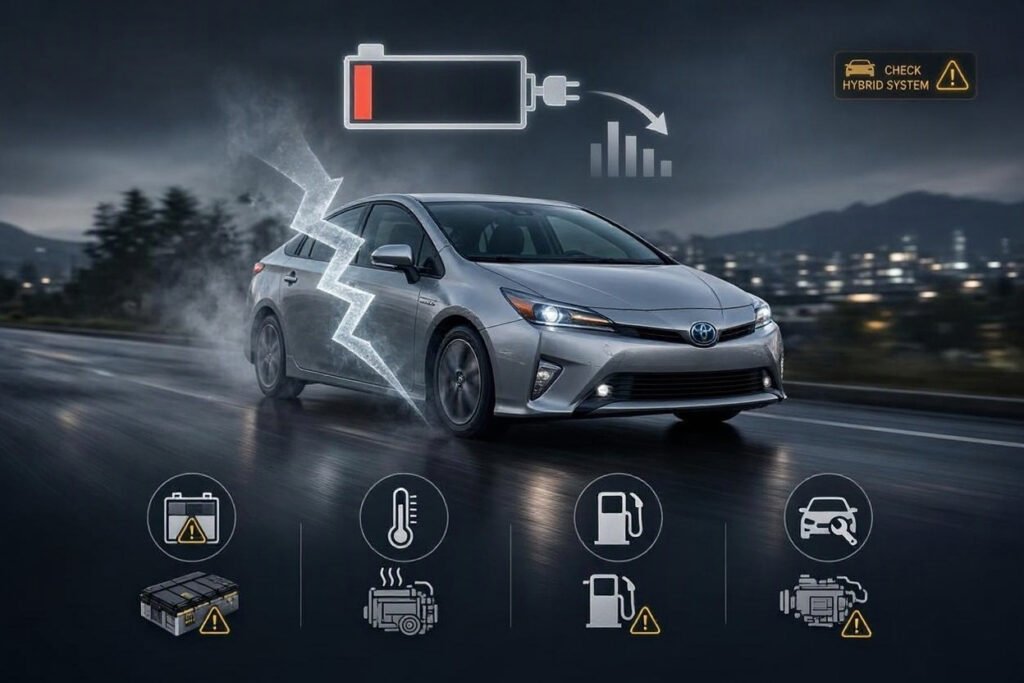
A hybrid car can lose power because its battery cannot deliver the required current, its inverter is too hot, its motor is operating under a protective limit, or its gasoline engine cannot produce expected output.
In some cases, the problem begins in one subsystem and becomes visible because another subsystem cannot compensate.
A battery with acceptable stored energy may have restricted power capability. An inverter may reduce motor output to protect its semiconductor components. An engine may lose power because fuel delivery is inadequate. A control module may limit propulsion after detecting an abnormal electrical or mechanical condition.
The difference between gradual performance reduction and abrupt power loss is therefore important. Gradual changes can reflect increasing thermal or electrical restrictions, while sudden changes may indicate a fault or protective transition that requires immediate attention.
The most reliable diagnosis comes from combining the driving symptoms, warning messages, stored diagnostic trouble codes, and live operating data. A hybrid powertrain is a coordinated system, and its power output depends on every component being able to perform its assigned role safely.