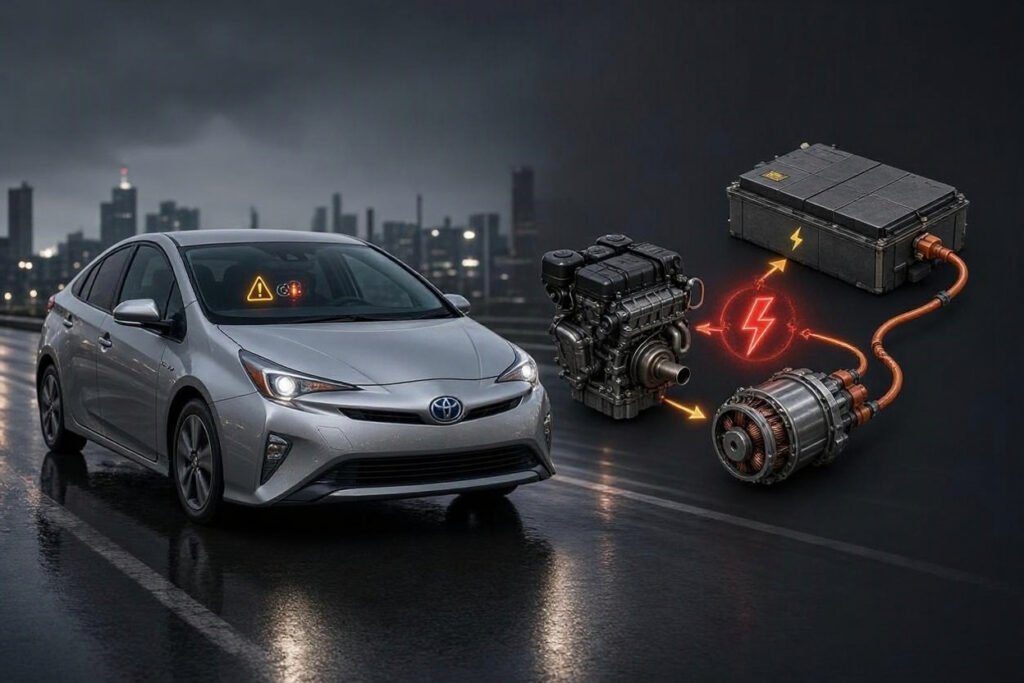
A hybrid vehicle can have a traction battery containing substantial stored energy and still remain completely unresponsive when its 12-volt auxiliary battery becomes discharged. The dashboard may fail to illuminate, the electronic locks may stop responding, or the vehicle may display electrical warnings without entering READY mode.
To an owner familiar with conventional cars, this seems contradictory. If the hybrid battery contains enough energy to propel the vehicle, why can a relatively small 12-volt battery prevent it from starting?
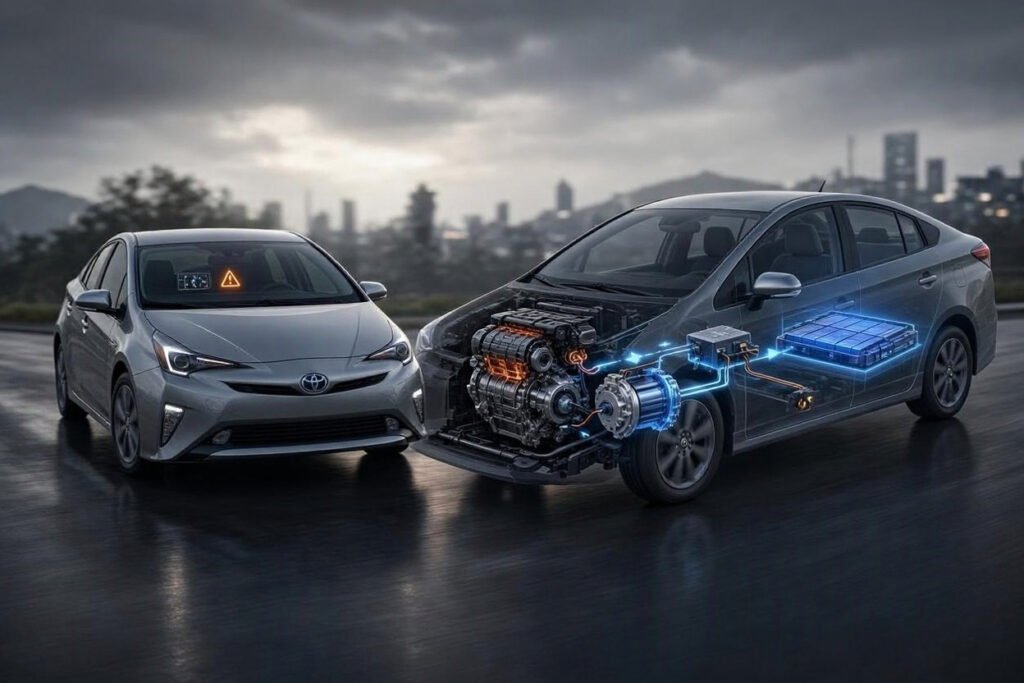
The explanation is that these batteries perform different jobs. The high-voltage traction battery supplies energy for electric propulsion, while the auxiliary battery supports the low-voltage electrical network responsible for operating control modules, communication systems, relays, and other essential equipment. The vehicle needs the low-voltage system to function before it can safely activate the high-voltage powertrain.
A hybrid vehicle can often be jump-started when its 12-volt auxiliary battery is discharged, but the procedure is not automatically identical to jump-starting a conventional car. The correct connection points, equipment requirements, and sequence depend on the vehicle manufacturer. The high-voltage traction battery must never be treated as an ordinary jump-start battery.
Two Batteries, Two Different Electrical Responsibilities
The most important distinction in hybrid jump-starting is the separation between low-voltage and high-voltage electrical systems.
Although both systems contribute to vehicle operation, they are designed around different electrical demands and safety requirements.
The 12-volt auxiliary battery: The vehicle’s electronic starting point
A conventional vehicle uses its 12-volt battery to power the starter motor, ignition electronics, lighting, instruments, and other electrical equipment.
A hybrid uses a 12-volt battery for many of the same low-voltage functions, but its role in the startup sequence is especially important.
The auxiliary battery commonly supports:
- Body control modules.
- Instrument clusters and dashboard displays.
- Electronic locks and security systems.
- Keyless-entry and immobilizer electronics.
- Brake-system control electronics.
- Communication networks between vehicle modules.
- Relays and control circuits involved in system activation.
The exact distribution of electrical loads varies by design, but the underlying principle remains consistent: the vehicle needs a functioning low-voltage supply to coordinate its electronic systems.
A hybrid may not use a conventional starter motor in the same way as a gasoline-only vehicle, yet it still needs sufficient low-voltage power to establish the conditions required for READY mode.
This explains why a discharged auxiliary battery can immobilize a hybrid even when its traction battery is healthy.
The high-voltage traction battery: The propulsion energy source
The traction battery operates at a much higher voltage than the auxiliary electrical system. It supplies energy to the electric motor or motor-generators through power electronics, particularly the inverter.
Depending on the vehicle architecture, this battery may also support energy conversion, engine starting, regenerative braking, and other powertrain functions.
Its operating conditions are monitored by a battery management system (BMS).
The BMS evaluates factors such as:
- Individual cell or module voltage.
- Battery temperature.
- Charging and discharging current.
- Estimated state of charge.
- Permitted charging and discharging power.
- Electrical and thermal protection limits.
The battery is connected to the propulsion system through high-voltage contactors and associated safety circuits. It is not intended to serve as a convenient external starting terminal.
The auxiliary battery and traction battery are therefore not interchangeable. A jump-start source intended for a conventional 12-volt system cannot be connected to high-voltage components.
Why a Healthy Traction Battery Cannot Automatically Start the Vehicle
Imagine a hybrid parked overnight. Its traction battery has an acceptable state of charge, but the 12-volt auxiliary battery has become discharged.
The owner presses the power button. Nothing happens, or the dashboard illuminates briefly before going dark.
The natural assumption might be that the large hybrid battery should provide enough electricity to activate the vehicle.
However, the system cannot simply bypass its low-voltage control architecture.
Startup requires electronic authorization
Before the high-voltage system becomes available, the vehicle’s control modules must establish that the operating conditions are acceptable.
Depending on the model, this process can involve the body control module, hybrid control unit, battery management system, immobilizer, brake electronics, and other controllers.
The system may need to verify that:
- The authorized key is recognized.
- The brake pedal is being pressed.
- The transmission selector is in an acceptable position.
- Required safety circuits are functioning.
- No critical electrical fault prevents activation.
- The high-voltage battery and associated equipment are available.
These checks depend on the low-voltage electrical network.
If the auxiliary battery cannot maintain adequate voltage, control modules may fail to initialize, communication between systems may become unreliable, or relays may not operate as intended.
The high-voltage battery may contain enough energy for propulsion, but the vehicle cannot safely authorize its use.
Why a small voltage drop can create a major starting problem
A weak 12-volt battery may still illuminate some dashboard indicators or operate the electronic locks.
That does not prove it can support the complete activation sequence.
When several control modules, relays, and other electrical loads become active, the battery voltage may fall further. Excessive voltage drop can cause modules to reset, communication errors to appear, or activation attempts to fail.
The symptoms can be confusing because different systems may respond inconsistently.
For example, the instrument cluster might illuminate while the hybrid control unit fails to complete initialization. A warning message may appear even though the underlying issue is inadequate low-voltage supply.
This is why testing the auxiliary battery under appropriate conditions is more informative than judging its condition by whether the dashboard lights work.
How the DC-to-DC Converter Connects the Two Electrical Systems
The relationship between the batteries becomes clearer once the vehicle enters READY mode.
Many full hybrids use a DC-to-DC converter to reduce high-voltage electrical energy to the low-voltage level required by the auxiliary network.
In a conventional vehicle, an alternator typically performs the task of supporting the 12-volt electrical system and replenishing the battery while the engine runs.
In many hybrids, the DC-to-DC converter performs the corresponding function when the high-voltage system is active.
Why the converter cannot always rescue a discharged auxiliary battery
The converter generally depends on the vehicle successfully activating its high-voltage electrical system.
That creates a startup dependency:
- The low-voltage system powers the control electronics.
- The control electronics perform the required checks.
- The hybrid system establishes its high-voltage operating state.
- The DC-to-DC converter can then support the low-voltage network.
If the auxiliary battery is too weak to complete the initial stages, the converter may never become available to support it.
This explains a common misunderstanding: the vehicle may have a system capable of charging its 12-volt battery from the traction battery, yet still require an external low-voltage power source to reach the point where that charging system can operate.
The converter does not make the auxiliary battery irrelevant. It changes how that battery is maintained during vehicle operation.
What Actually Happens During a Model-Approved Jump-Start?
When a hybrid manufacturer permits external jump-starting, the purpose is normally to restore adequate low-voltage power so the vehicle can complete its activation sequence.
It is not an attempt to charge or directly activate the high-voltage traction battery.
The distinction is critical.
The external source supports the low-voltage network
An approved jump-start arrangement supplies electrical power to the designated low-voltage connection points.
Once sufficient voltage is available, the vehicle may be able to initialize its control modules, recognize the key, verify the brake input, and complete the READY-mode sequence.
If the underlying problem is simply a discharged auxiliary battery, the vehicle may then become operational.
After the high-voltage system activates, its DC-to-DC converter may support the low-voltage electrical network, depending on the design.
However, successful activation does not prove that the auxiliary battery is healthy. A battery that has deteriorated, suffered an internal fault, or repeatedly discharged may require testing and replacement.
Why connection points are not universal
Some hybrids provide designated jump-start terminals in the engine compartment, even when the actual 12-volt battery is located elsewhere.
Other vehicles provide access to the auxiliary battery directly or use a different arrangement.
The physical location of the battery does not necessarily identify the correct external connection points.
Manufacturers may specify particular terminals, grounding locations, polarity arrangements, and equipment requirements. These details matter because the vehicle’s electrical architecture can be sensitive to incorrect connections.
A procedure suitable for one hybrid should not be assumed to apply to another.
For that reason, a model-specific owner’s manual or manufacturer-approved service information must determine the correct procedure. Generalized instructions are not a safe substitute.
Why the High-Voltage Battery Must Never Be Jump-Started Like a 12-Volt Battery
The most dangerous misunderstanding is treating the high-voltage traction battery as a larger version of a conventional car battery.
It is not.
A traction battery contains multiple cells or modules arranged to provide the voltage and power required by the propulsion system. Its electrical connections, insulation, contactors, monitoring circuits, and protection systems are designed around high-voltage operation.
High-voltage contactors isolate the battery
The traction battery is normally separated from the vehicle’s high-voltage bus by electrically controlled contactors.
These switches are coordinated by the vehicle’s control system and operate only when required safety conditions are satisfied.
Many systems also use a precharge circuit to manage the initial connection to high-voltage components containing capacitors, particularly within the inverter.
This helps control the current that flows when the high-voltage circuit is activated.
A conventional jump-start procedure has no role in bypassing this arrangement.
Attempting to connect an external power source to high-voltage terminals, bypass contactors, or interfere with the battery isolation system can create severe electrical hazards and damage expensive components.
Orange cables are not ordinary electrical wiring
Hybrid vehicles commonly use distinctive high-voltage cable identification, often including orange insulation.
These cables connect the traction battery with components such as the inverter, electric motor, and other high-voltage equipment.
They should not be disconnected, tested casually, or used as connection points.
Even when a vehicle is switched off, high-voltage components may retain dangerous electrical energy. Internal capacitors and battery components can present hazards that are not eliminated simply by removing the key or turning off the power button.
High-voltage diagnosis requires appropriate training, protective equipment, and manufacturer-approved procedures.
The safe distinction is straightforward: a permitted jump-start concerns the designated low-voltage system, never the high-voltage traction battery.
How Different Hybrid Designs Affect Jump-Starting
The basic separation between auxiliary and traction systems applies across many hybrid vehicles, but their electrical arrangements are not identical.
Full hybrids (HEVs)
Full hybrids typically use a high-voltage traction battery and electric motor capable of contributing substantially to propulsion.
The 12-volt auxiliary system supports the control electronics and other low-voltage equipment.
If the auxiliary battery becomes discharged, the vehicle may fail to enter READY mode even when the traction battery is charged.
A manufacturer-approved low-voltage jump-start may restore the conditions needed for activation.
Plug-in hybrids (PHEVs)
Plug-in hybrids use larger traction batteries designed for extended electric driving.
Their greater battery capacity does not remove the need for a functioning low-voltage network.
A PHEV can therefore experience the same basic problem: sufficient high-voltage energy may be present, but the vehicle cannot initialize because the auxiliary battery is discharged.
Some PHEVs have additional charging-related electronics and control requirements, making model-specific procedures particularly important.
Mild hybrids
Mild hybrids commonly use a smaller electrical system than full hybrids, although their voltage architecture varies.
They may use a belt-driven starter-generator or integrated starter-generator to support engine restarting, acceleration assistance, and energy recovery.
Some mild-hybrid designs operate with a 12-volt system, while others use higher-voltage arrangements such as 48 volts alongside a conventional low-voltage network.
Their jump-start requirements can therefore differ from those of full hybrids.
A 48-volt system should not be treated as an ordinary 12-volt battery, and its components should not be used as conventional jump-start terminals.
The owner’s manual remains the controlling source for identifying permitted external power connections.
When Jump-Starting Does Not Solve the Problem
A hybrid that fails to enter READY mode after an approved low-voltage jump-start may have a different problem.
Restoring electrical supply does not repair a failed component or override a protective shutdown.
Several conditions can produce similar symptoms.
A deteriorated auxiliary battery
A battery may accept temporary external power but fail again when that support is removed.
Internal deterioration, reduced capacity, or abnormal voltage behavior can prevent reliable operation.
A proper battery test can help distinguish a discharged battery from one that can no longer perform its intended function.
Poor connections or electrical resistance
Corroded terminals, loose connections, damaged wiring, and poor ground points can interfere with current flow.
In such cases, an external power source may not solve the problem if the electrical connection between the source and the vehicle is defective.
The vehicle may also show intermittent electrical symptoms rather than a complete loss of power.
A fault in the high-voltage system
If the low-voltage supply is healthy but READY mode remains unavailable, the problem may involve the traction battery, battery contactors, precharge circuit, inverter, insulation monitoring, or another hybrid-system component.
The high-voltage battery management system may have detected a condition that prevents activation.
Jump-starting the auxiliary system cannot correct an underlying high-voltage fault.
Safety interlock and authorization problems
A vehicle may also refuse to enter READY mode because it cannot verify the brake-pedal signal, key authorization, transmission position, or another required condition.
A weak key-fob battery, faulty brake switch, selector sensor problem, or immobilizer fault may produce a starting complaint that resembles a discharged auxiliary battery.
These faults require diagnosis rather than repeated attempts to supply external power.
Why Battery Temperature and Electrical Condition Still Matter
The high-voltage battery’s temperature and electrical condition are not usually the primary concern during an ordinary 12-volt jump-start, but they can influence whether the vehicle becomes operational after low-voltage power is restored.
Temperature affects available traction-battery power
Cold battery cells generally have higher internal resistance and may deliver less power. Excessive heat can also cause the battery management system to reduce permitted power to protect the cells.
A vehicle may successfully enter READY mode but display restricted propulsion or a hybrid-system warning if battery conditions prevent normal operation.
That is different from a jump-start failure.
State of charge and cell voltage affect system availability
The BMS monitors the traction battery’s SOC and individual cell or module voltage conditions.
If the battery is too low, imbalanced, or operating outside permitted limits, the system may restrict high-voltage activation or propulsion.
A jump-start source connected to the low-voltage system does not restore the traction battery’s stored energy or correct a cell-level problem.
This distinction helps prevent unnecessary replacement of a healthy auxiliary battery when the actual issue lies elsewhere.
What Happens After the Vehicle Enters READY Mode?
A successful jump-start is only the beginning of the investigation.
Once the vehicle enters READY mode, the owner should follow the manufacturer’s instructions about how long to keep it operating and whether the auxiliary battery needs testing or replacement.
The presence of READY generally indicates that the vehicle’s propulsion system has become available, but it does not guarantee that the auxiliary battery has recovered its full capacity.
The DC-to-DC converter may support the low-voltage network while the vehicle is operational. However, if the battery has suffered internal damage or repeatedly loses charge, the underlying problem can return after the vehicle is switched off.
A technician may need to examine:
- Auxiliary battery condition and capacity.
- Low-voltage charging-system operation.
- Parasitic electrical loads while parked.
- Terminal and ground connections.
- Relevant stored diagnostic trouble codes.
- Hybrid-system faults that may have caused abnormal power consumption.
A recurring discharge should not automatically be attributed to the battery itself. A faulty module that remains awake, an electrical accessory, a charging-system problem, or damaged wiring may be responsible.
The Practical Safety Boundary for Hybrid Jump-Starting
The important question is not whether every hybrid can be jump-started. It is whether the specific vehicle permits external power to be applied to its low-voltage system and how its manufacturer requires that operation to be performed.
Owners should avoid:
- Connecting a jump-start source to orange high-voltage cables.
- Attempting to access or bypass traction-battery terminals.
- Guessing the polarity or location of connection points.
- Using an unsuitable power source or equipment.
- Assuming that a conventional car’s procedure applies to a hybrid.
- Repeatedly attempting activation when the vehicle displays a high-voltage or electrical-system warning.
If the correct low-voltage procedure is unclear, roadside assistance or a qualified hybrid technician is the safer option.
A damaged, flooded, or collision-affected hybrid requires additional caution because its high-voltage isolation and safety systems may no longer be operating as intended.
Why the 12-Volt Battery Can Immobilize a Vehicle With a Much Larger Battery
A hybrid’s electrical architecture is built around cooperation, not simple battery size.
The traction battery stores energy for propulsion, while the auxiliary battery supports the electronics that authorize and coordinate vehicle operation. The DC-to-DC converter connects these systems during normal operation, but it does not eliminate the need for a functioning low-voltage supply during initial activation.
This explains why a hybrid can have a charged high-voltage battery and still refuse to enter READY mode.
It also explains why jump-starting a hybrid is fundamentally a low-voltage recovery procedure rather than an attempt to energize the propulsion battery.
The correct approach depends on the vehicle’s design. Some hybrids provide convenient external jump-start terminals; others use different arrangements. Mild hybrids, full hybrids, and plug-in hybrids may also have different voltage architectures and operating requirements.
A hybrid can often be jump-started when its auxiliary battery is discharged, but only through the connection points and procedure approved for that model. Treating the high-voltage traction system like a conventional battery is not merely incorrect—it can create serious safety risks.