A hybrid car can display an unusual electrical symptom: the dashboard lights illuminate, the instrument panel responds, and the vehicle appears to have power, yet pressing the start button produces no READY indicator. In another situation, the READY light comes on immediately, but the gasoline engine remains silent. A third vehicle may show almost no electrical response at all.
These situations can look like variations of the same starting problem. Mechanically and electrically, however, they can represent three different conditions.
Understanding why a hybrid car sometimes refuses to start requires looking beyond the conventional relationship between an ignition key, a starter motor, and an internal combustion engine. In a hybrid vehicle, starting involves low-voltage electronics, high-voltage battery control, safety interlocks, electronic authorization, and, when combustion is required, a separate engine-starting process.

The distinction matters because a hybrid vehicle does not necessarily need its gasoline engine to start immediately. It must first establish the conditions required for the vehicle’s propulsion system to become operational. Only after that can its control system decide whether the engine needs to run.
The First Diagnostic Question: Did the Vehicle Actually Enter READY Mode?
The most useful starting point is not whether the engine makes noise. It is whether the vehicle has successfully entered its operational state.
In many conventional cars, the driver turns the ignition, the starter motor rotates the engine, and the engine begins running. The process is relatively easy to recognize because engine operation is the primary indication that the vehicle has started.
A hybrid follows a different sequence.
When the driver presses the power button or operates the ignition control, the vehicle’s electronic systems begin an authorization and initialization process. Depending on the design, this involves the body control module, powertrain control module, battery management system, immobilizer, brake-system electronics, and hybrid control unit.
The vehicle checks whether the required conditions are satisfied. These can include:
- Whether the key fob or authorized key is detected.
- Whether the brake pedal is being pressed.
- Whether the transmission selector is in Park or Neutral, as required by the manufacturer.
- Whether the low-voltage electrical supply is adequate.
- Whether the high-voltage battery system is available.
- Whether the battery contactors and associated safety circuits can operate correctly.
- Whether any critical control-system fault prevents propulsion activation.
If the checks succeed, the vehicle enters READY mode.
READY means that the vehicle’s propulsion system is available. It does not necessarily mean that the gasoline engine is running.
This is the first important distinction in hybrid starting diagnosis: a vehicle that cannot enter READY mode has a different problem from one that enters READY mode but does not start its engine.
The dashboard may illuminate in both situations, but illumination alone does not prove that the hybrid system is operational.
Why the 12-Volt Battery Can Prevent a Hybrid From Starting
One of the most confusing hybrid starting failures occurs when the high-voltage battery appears to be charged, yet the vehicle refuses to enter READY mode.
The explanation often begins with the much smaller 12-volt battery.
The low-voltage battery operates the control system
A hybrid vehicle normally uses a low-voltage electrical system to power many of the same functions found in a conventional vehicle. These include control modules, instrument displays, lighting, relays, electronic locks, communication networks, and other electrical equipment.
The 12-volt battery also supports the initial activation sequence. Before the high-voltage propulsion system can be made available, the vehicle needs functioning electronic controls capable of checking safety conditions and coordinating the startup process.
This creates an important dependency.
The high-voltage battery may contain substantial stored energy, but the vehicle still needs a functioning low-voltage system to authorize and control access to it.
A weak 12-volt battery can therefore produce symptoms such as:
- Dashboard lights that flicker or behave inconsistently.
- Clicking sounds without successful READY activation.
- Warning messages appearing during startup.
- Multiple unrelated electrical faults.
- Intermittent communication errors between control modules.
- A vehicle that responds to the power button but never enters READY mode.
The symptoms can resemble a serious high-voltage battery failure even when the actual problem is in the low-voltage supply.
Why dashboard illumination does not prove the battery is healthy
A dashboard may illuminate even when the 12-volt battery cannot maintain the electrical conditions required for the complete startup sequence.
Lighting the instrument panel and activating several control modules are not necessarily equivalent electrical demands. Voltage may fall when additional systems activate, particularly if the battery has deteriorated, connections have excessive resistance, or a charging problem has left it undercharged.
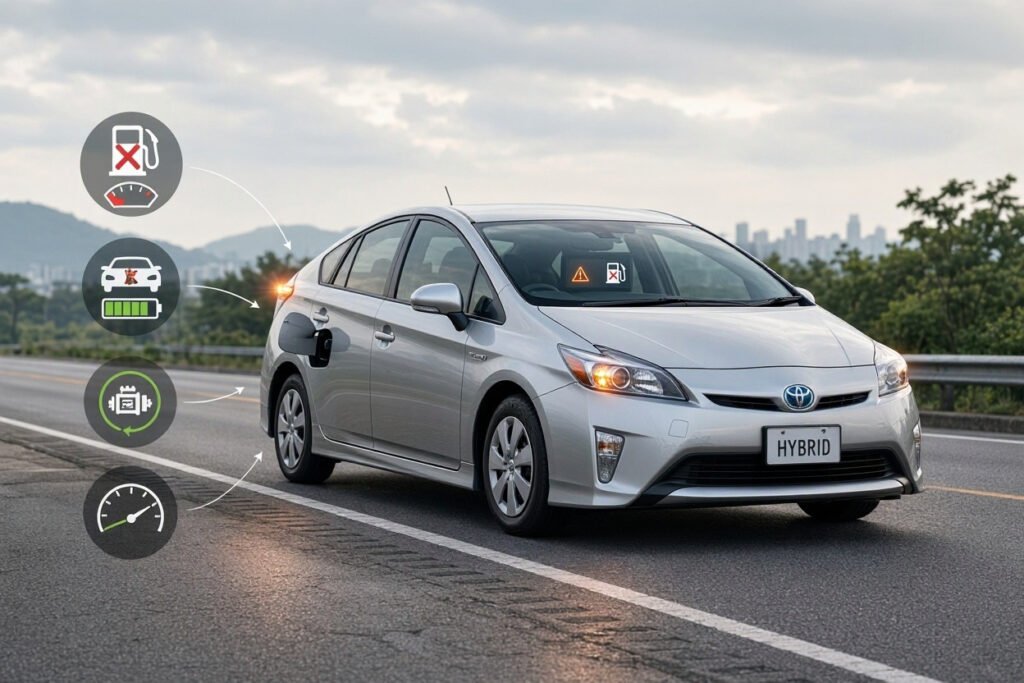
The result can be misleading: the vehicle appears electrically alive, but its control system cannot complete initialization.
A weak battery is not the only possibility. Corroded terminals, loose connections, damaged ground points, defective fuses, or a malfunctioning low-voltage charging system can produce similar symptoms.
How the hybrid maintains the 12-volt system
Many full hybrids use a DC-to-DC converter to reduce voltage from the high-voltage electrical system and support the low-voltage network. This performs a role that a conventional alternator would otherwise perform in many gasoline vehicles.
However, the converter generally cannot support normal vehicle operation until the hybrid system has been activated.
This explains why a hybrid with a discharged 12-volt battery may fail to start even though its main battery is not necessarily empty.
The two batteries perform different functions. A healthy high-voltage battery cannot automatically compensate for a low-voltage system that cannot initialize the vehicle.
The High-Voltage Battery: Stored Energy Is Not the Same as Available Power
If the 12-volt system is functioning correctly, attention may shift to the high-voltage battery and its control electronics.
A hybrid battery is not simply a large collection of cells connected to an electric motor. It is part of a monitored electrical system in which the battery management system evaluates voltage, temperature, current, and operating limits.
The battery management system must determine whether the pack can safely provide the power required for propulsion.
State of charge does not tell the whole story
A battery can show a reasonable state of charge (SOC) while still being unable to deliver the power demanded by the vehicle.
SOC estimates the amount of usable stored energy relative to the battery’s operating capacity. It does not directly describe the battery’s instantaneous power capability.
For example, a battery may have sufficient stored energy but experience a restriction because:
- One or more cells have reached an electrical protection limit.
- Battery temperature is outside the preferred operating range.
- Internal resistance has increased.
- Cell voltages are significantly imbalanced.
- A battery sensor is reporting implausible information.
- The battery management system has detected a fault.
The control system evaluates these conditions before allowing the battery to support normal propulsion.
A hybrid vehicle may therefore refuse to enter READY mode, enter a restricted operating state, or display a hybrid-system warning, depending on the nature and severity of the detected condition.
How cell voltage influences battery availability
Individual battery cells operate within defined voltage limits. The battery management system monitors cell groups or modules, depending on the architecture, to prevent operation outside permitted boundaries.
A pack’s overall voltage can appear acceptable while one weak cell or module approaches a protective limit.
This is particularly important because battery cells connected in series share the same current. A cell with reduced capacity or unusual internal resistance can reach its voltage boundary earlier than the others during charging or discharging.
If the system detects a potentially damaging condition, it may reduce the permitted current or power.
The vehicle’s control system then has to determine whether the remaining available electrical capability is sufficient for propulsion.
A low state of charge alone does not necessarily mean a hybrid will refuse to start. Many full hybrids are designed to manage engine operation and battery charging within a protected operating range. However, an unusually low battery condition, an electrical fault, or a problem preventing the system from restoring an acceptable operating state can interfere with READY activation.
Temperature can restrict power without indicating permanent failure
Battery temperature is another important variable.
At low temperatures, electrochemical reactions become less responsive and internal resistance can increase. The battery may be unable to accept or deliver the same power available under more favorable conditions.
At high temperatures, the management system may reduce electrical loading to limit further heating and protect cell life.
These restrictions are not automatically evidence of a failed battery.
A cold battery may temporarily deliver less power. A hot battery may temporarily operate under reduced power limits. Once temperatures return to an acceptable range, some restrictions may disappear.
The distinction is between a protective limitation and a genuine malfunction. A battery operating under reduced power limits may still be healthy, whereas persistent voltage imbalance, abnormal sensor readings, insulation faults, or repeated battery-system warnings require professional diagnosis.
The High-Voltage Contactors: Why a Charged Battery May Remain Disconnected
A high-voltage battery is not normally connected permanently to the vehicle’s propulsion electronics.
It is isolated through electrically controlled contactors. These heavy-duty switches connect or disconnect the battery from the high-voltage system when the vehicle’s operating conditions permit.
This arrangement is an essential part of hybrid electrical safety.
What happens during activation?
When the driver requests READY mode, the vehicle’s control system performs a sequence of checks. If the necessary conditions are satisfied, the battery contactors can be commanded to close.
Many systems also use a precharge circuit. Its purpose is to manage the initial connection between the battery and high-voltage components containing capacitors, particularly within the inverter.
Without controlled precharging, connecting a battery directly to an uncharged electrical circuit could create a large inrush current.
The precharge process helps bring the relevant electrical potentials closer together before the main contactors complete the connection.
If the system detects an abnormal precharge response, an electrical fault, or an unsafe condition, it may prevent full high-voltage activation.
The driver may then experience a vehicle that has normal-looking dashboard activity but never reaches READY.
What can interrupt this process?
Possible causes include:
- A defective high-voltage contactor.
- A problem in the precharge circuit.
- A high-voltage interlock fault.
- An insulation-resistance problem.
- A damaged or disconnected high-voltage component.
- A battery management or monitoring fault.
- A control-module communication failure.
The battery may still contain energy, but the vehicle cannot safely establish the electrical connection required for propulsion.
This is why a high-voltage warning should not be treated as an invitation to inspect battery cables or open the battery enclosure. Hybrid systems can retain dangerous electrical energy even when the vehicle is switched off.
High-voltage diagnosis belongs to appropriately trained technicians using manufacturer-approved procedures and equipment.
Safety Interlocks: When the Vehicle Deliberately Refuses the Start Request
Not every failure to enter READY mode is caused by a battery or propulsion-system defect.
Hybrid vehicles depend on several safety conditions that must be satisfied before movement is permitted.
These conditions are often called interlocks. They prevent the vehicle from activating propulsion when the control system cannot confirm that the operating situation is safe.
Brake-pedal recognition
Many hybrids require the driver to press the brake pedal before activating READY mode.
The system does not rely solely on the driver’s physical action. It also needs an electronic signal confirming that the brake pedal has been operated.
A faulty brake-pedal switch, damaged wiring, or an electrical communication problem can prevent the vehicle from recognizing the request.
The driver may press the pedal correctly while the vehicle behaves as if no braking input has been applied.
Depending on the model, the brake lights may also behave abnormally, although brake-light behavior alone is not a definitive diagnosis.
Transmission position and selector recognition
A hybrid generally requires the transmission control system to confirm an acceptable selector position before propulsion activation.
If the vehicle is not recognized as being in Park or another permitted position, the system may reject the start request.
A selector-position sensor, electronic shift-by-wire fault, wiring problem, or control-module communication issue can interfere with this process.
The selector may physically appear to be in Park while the electronic system is receiving an inconsistent signal.
Key recognition and immobilizer authorization
The vehicle must also establish that an authorized key is present.
A weak key-fob battery, radio-frequency interference, damaged key, antenna fault, or immobilizer communication problem can prevent authorization.
Some vehicles provide an alternative emergency key-recognition procedure, but the exact method varies by manufacturer.
A key-related warning should therefore be investigated separately from a high-voltage battery warning. Replacing the main hybrid battery would not correct a failed immobilizer signal.
Other safety-related conditions
Depending on the vehicle, additional interlocks may involve charging-cable connection, high-voltage service disconnect status, crash detection, hood or door-related operating logic, and other safety signals.
Not every hybrid uses the same conditions, and not every warning prevents READY mode.
The important diagnostic principle is that the vehicle may be refusing to activate because it has not received a required authorization signal—not because it lacks electrical energy.
When READY Appears but the Gasoline Engine Does Not Start
This is where hybrid starting behavior becomes particularly easy to misunderstand.
A hybrid that displays READY has generally completed the necessary activation process. The gasoline engine, however, may remain completely silent.
In many circumstances, that is normal.
Electric propulsion can begin without engine operation
A full hybrid can often move using its electric motor alone, depending on battery condition, vehicle speed, power demand, temperature, and control strategy.
The engine may remain off when the battery can provide the required power and the operating conditions permit electric propulsion.
When the driver requests more power, the battery’s available output becomes insufficient, or the engine is needed for thermal or energy-management reasons, the control system can start the engine.
Consequently, pressing the power button and hearing no gasoline-engine noise does not necessarily indicate a starting failure.
The vehicle may already be fully operational.
The engine does not always use a conventional starter motor
Many full hybrids use a motor-generator integrated into the powertrain to start the gasoline engine.
Depending on the architecture, the motor-generator can rotate the engine without requiring a conventional starter motor and pinion arrangement.
In some systems, a dedicated starter may still be present, particularly in certain mild-hybrid or manufacturer-specific designs.
The starting method depends on the powertrain configuration.
In a power-split hybrid, for example, motor-generators and a planetary gear arrangement coordinate engine speed and wheel propulsion. In a parallel hybrid, the electric motor may be positioned between the engine and transmission or integrated elsewhere in the drivetrain. A series hybrid can use its engine primarily to drive a generator rather than mechanically drive the wheels.
These differences affect how the engine is started and what components must operate correctly.
When a requested engine start fails
A more meaningful problem occurs when the vehicle’s control system requests engine operation but the engine does not start.
Potential causes include:
- A fault in the motor-generator or its control circuit.
- An inverter or power-electronics problem.
- A failure in engine-start authorization.
- An engine-control or sensor fault.
- An immobilizer-related restriction.
- Insufficient fuel pressure or fuel delivery.
- Ignition-system problems in gasoline engines that use conventional spark ignition.
- Mechanical problems affecting engine rotation or combustion.
The vehicle may display READY while also showing a warning or entering a reduced-power operating mode.
In some designs, it may continue operating electrically for a limited period or under restricted conditions. In others, an engine-start fault may prevent normal driving.
The correct response depends on the warning messages, diagnostic trouble codes, and manufacturer-specific operating strategy.
The Fuel System: A Hybrid Engine Still Needs Combustion to Run
Hybrid technology changes how the engine operates, but it does not eliminate the requirements of internal combustion.
When the engine is commanded to start, it still needs an adequate supply of fuel, air, and ignition energy, along with correct mechanical timing and compression.
A hybrid can therefore have a fuel-system problem even when its electric propulsion system is functioning normally.
Why fuel problems may appear differently in hybrids
Because a full hybrid can operate with the engine switched off, drivers may not notice an engine-related problem immediately.
For example, the vehicle may enter READY mode and move electrically under light demand. When the control system later requests engine operation, the engine may fail to start or may start and then stop unexpectedly.
Potential fuel-related causes include:
- An empty or incorrectly indicated fuel tank.
- A failed fuel pump.
- Insufficient fuel pressure.
- A blocked fuel filter, where a serviceable filter is fitted.
- Faulty fuel injectors.
- Contaminated fuel.
- Fuel-pressure sensor or wiring problems.
Some hybrid vehicles also use fuel-system monitoring strategies that differ from those of conventional cars. Fuel-tank pressure monitoring and evaporative-emissions controls can generate warnings without necessarily preventing READY activation.
A fuel-related diagnostic code should not automatically be interpreted as proof that the fuel pump has failed. The underlying issue may involve a sensor, electrical supply, control circuit, or another component.
Why a hybrid can have a charged battery but still need the engine
A plug-in hybrid may begin a journey with substantial battery charge and operate electrically for much of the trip. That does not mean the gasoline engine is permanently optional.
The engine may be required for higher power demand, particular temperature conditions, battery management, or other manufacturer-defined operating strategies.
If the engine cannot start when requested, the vehicle may lose access to an important part of its intended operating capability.
An engine-start problem should therefore be distinguished from a vehicle that is simply choosing electric propulsion.
Three Different Symptoms Require Three Different Diagnostic Paths
The practical value of these distinctions becomes clear when the symptoms are compared.
| Observed condition | What it suggests | Areas requiring investigation |
|---|---|---|
| No electrical response or almost no dashboard activity | The low-voltage electrical system may not be supplying power | 12-volt battery, terminals, grounds, main fuses, low-voltage wiring |
| Dashboard illuminates, but READY does not appear | Startup authorization or system initialization has not completed | 12-volt supply, key recognition, brake signal, selector position, high-voltage interlocks, contactors, control modules |
| READY appears, but the gasoline engine remains silent | The hybrid may be operating normally in electric mode, or an engine-start request may not be completing | Engine operating conditions, battery power availability, motor-generator, inverter, fuel and engine-control systems |
Case 1: No electrical response
If the vehicle produces almost no electrical activity, investigating the gasoline engine first is unlikely to be useful.
The initial concern is whether the low-voltage network has sufficient electrical supply.
A discharged 12-volt battery, poor terminal connection, damaged ground, blown main fuse, or wiring fault can prevent the vehicle’s electronic systems from becoming operational.
A qualified technician can test battery condition under load, verify voltage stability, inspect connections, and check the low-voltage charging system.
Case 2: Electrical activity without READY
When the dashboard works but READY does not appear, the diagnostic question changes.
The vehicle has enough electrical activity to illuminate the instrument panel, but something may be preventing completion of the startup sequence.
A scan tool capable of communicating with hybrid-specific control modules can help identify whether the system has detected a brake-switch fault, key authorization problem, high-voltage interlock issue, battery-management restriction, or contactor fault.
Reading only generic engine codes may miss important information stored in hybrid, body, or battery-control modules.
Case 3: READY appears without engine operation
This situation requires the greatest caution against misdiagnosis.
The driver must first determine whether the vehicle is actually being prevented from driving or whether the engine is simply not required at that moment.
If READY is displayed and the vehicle responds normally to the accelerator, the silent engine may be operating exactly as designed.
If the vehicle displays an engine warning, refuses to provide expected power, or repeatedly attempts and fails to start the engine, a different investigation is necessary.
The diagnostic process should establish whether the control system requested engine operation, whether the engine was physically rotated, and whether fuel, ignition, and engine-management conditions were satisfied.
Why Mild Hybrids, Full Hybrids, and Plug-In Hybrids Can Behave Differently
The phrase “hybrid car” covers several powertrain designs. Their starting systems should not be assumed to work identically.
Full hybrids (HEVs) can generally propel the vehicle electrically under suitable conditions. Their engine may start and stop repeatedly, with motor-generators handling engine starting in many designs. A silent engine after READY activation can be completely normal.
Plug-in hybrids (PHEVs) use a larger rechargeable battery and can provide extended electric driving. Their gasoline engine may remain off for much longer, but the vehicle still depends on the engine when its operating strategy requires it. A PHEV may also have charging-related interlocks or conditions that affect activation.
Mild hybrids generally use an integrated starter-generator or belt-driven starter-generator to assist the engine, recover energy, and support stop-start operation. Most are not designed to provide sustained electric-only propulsion. Their engine-starting behavior is therefore more closely tied to the combustion engine’s operating state.
Architecture matters as well. A series hybrid, parallel hybrid, and power-split hybrid distribute mechanical and electrical functions differently. The components involved in starting the engine, connecting the battery, and supplying propulsion power consequently vary.
Battery chemistry also influences control behavior. Nickel-metal hydride and lithium-ion systems have different electrical and thermal characteristics, but both require battery monitoring and protective operating limits. The battery management strategy is specific to the vehicle’s design.
When a Starting Problem Is a Protective Response Rather Than a Failed Component
A hybrid control system is designed to prevent operation when it cannot establish that important electrical or mechanical conditions are safe.
That means a refusal to enter READY mode can sometimes be the result of a deliberate protective decision.
For example, a high-voltage insulation fault may cause the system to isolate the battery. A battery-temperature sensor may report a condition that restricts operation. An interlock circuit may indicate that a high-voltage component is not securely connected.
In these circumstances, forcing the vehicle to start would defeat the purpose of the protection system.
The same distinction applies to temporary battery limitations. Cold temperatures, high temperatures, low available charge, or restricted cell voltage can reduce power availability without proving that the battery has permanently failed.
However, repeated warning messages, persistent READY-mode failure, abnormal electrical behavior, or a vehicle that becomes immobilized should not be dismissed as ordinary battery management.
A proper diagnosis requires stored fault codes, live data, electrical testing, and the manufacturer’s diagnostic procedure.
What Owners Should Avoid When a Hybrid Refuses to Start
A hybrid starting failure can tempt drivers to apply conventional troubleshooting methods. Some are inappropriate for high-voltage vehicles.
Do not assume that disconnecting the main hybrid battery will reset the problem. Do not open the battery enclosure, touch orange high-voltage cables, or attempt to bypass interlocks or contactors.
A conventional jump-start procedure should only be used if the owner’s manual specifically identifies the correct low-voltage connection points and procedure. Incorrect polarity, unsuitable equipment, or connection to an unintended terminal can damage electronic systems.
If the vehicle displays a high-voltage, isolation, or battery-system warning, professional diagnosis is particularly important. If it has suffered flooding, collision damage, or visible electrical damage, it should not be treated as an ordinary discharged-battery case.
The safest approach is to identify the exact symptom, record warning messages, and follow the manufacturer’s instructions for that model.
The Real Meaning of a Hybrid Starting Failure
A hybrid car does not have one single starting system in the conventional sense. It has an activation sequence that coordinates low-voltage power, high-voltage battery availability, electronic authorization, safety interlocks, power electronics, and engine control.
That is why three vehicles can appear to have the same problem while requiring completely different investigations.
A car with no electrical response may have a low-voltage supply problem. A car with dashboard activity but no READY indication may be failing an authorization or high-voltage initialization check. A car that displays READY while keeping its engine off may be functioning normally—or it may have a separate engine-start fault that becomes apparent only when combustion is requested.
The most useful diagnostic question is therefore not simply, “Why won’t the hybrid engine start?” It is, “Which stage of the vehicle’s operating sequence is failing?”
Once that distinction is established, the investigation becomes much more precise. It also reveals a defining feature of hybrid engineering: the vehicle must coordinate two electrical systems and a combustion powertrain while continuously deciding which sources of energy are available, safe, and necessary.